$61 Million, a Children's Hospital, and a Deal Made Without You.
This piece is based on public records, signed correspondence I have obtained, recorded statements made at the April 28, 2026 Apex Town Council meeting, and analysis of publicly available budget and capital improvement documents. Where I have drawn conclusions, I have tried to clearly distinguish between documented facts and my own interpretation. Where I have quoted Town officials, I have done my best to capture their statements accurately, but readers should consult the meeting recording for full context. If anything in this article is factually inaccurate, I want to know. Please contact me at adam@thepeakweekly.com and I will issue corrections promptly.
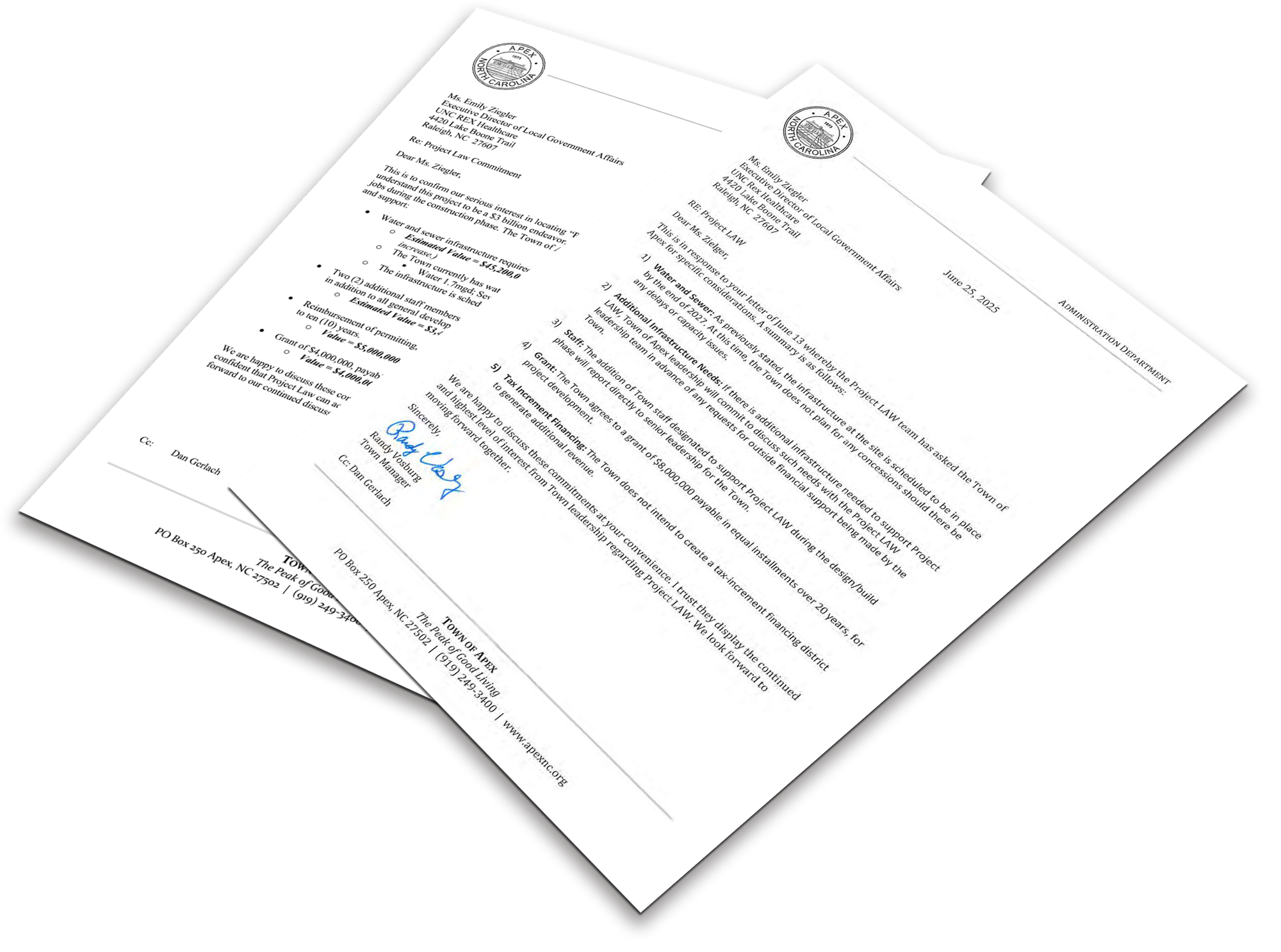
Below is a letter, signed by Town Manager Randy Vosburg on June 25, 2025. In it, he commits the Town of Apex to approximately $61 million in support of what is now publicly known as North Carolina Children's Hospital. He commits the Town to delivering 1.7 million gallons of drinking water per day. He commits Apex taxpayers to a multi-million-dollar grant, a $5 million fee reimbursement, and dedicated Town staff for ten years.
Here's the problem. He can't do that.
North Carolina open meetings law is very clear: economic development commitments of this scale are required to be approved in open session, by Town Council, with the public present.
The Town Manager cannot commit to the largest economic development investment in the Town's history without a public hearing and vote taking place. But he did it anyway.
Instead of the Town Council holding him accountable on Tuesday, they covered for him.
And you're paying for it.
First, the hospital itself
Let me say this clearly before anything else, because I want there to be no confusion about where I stand on this project.
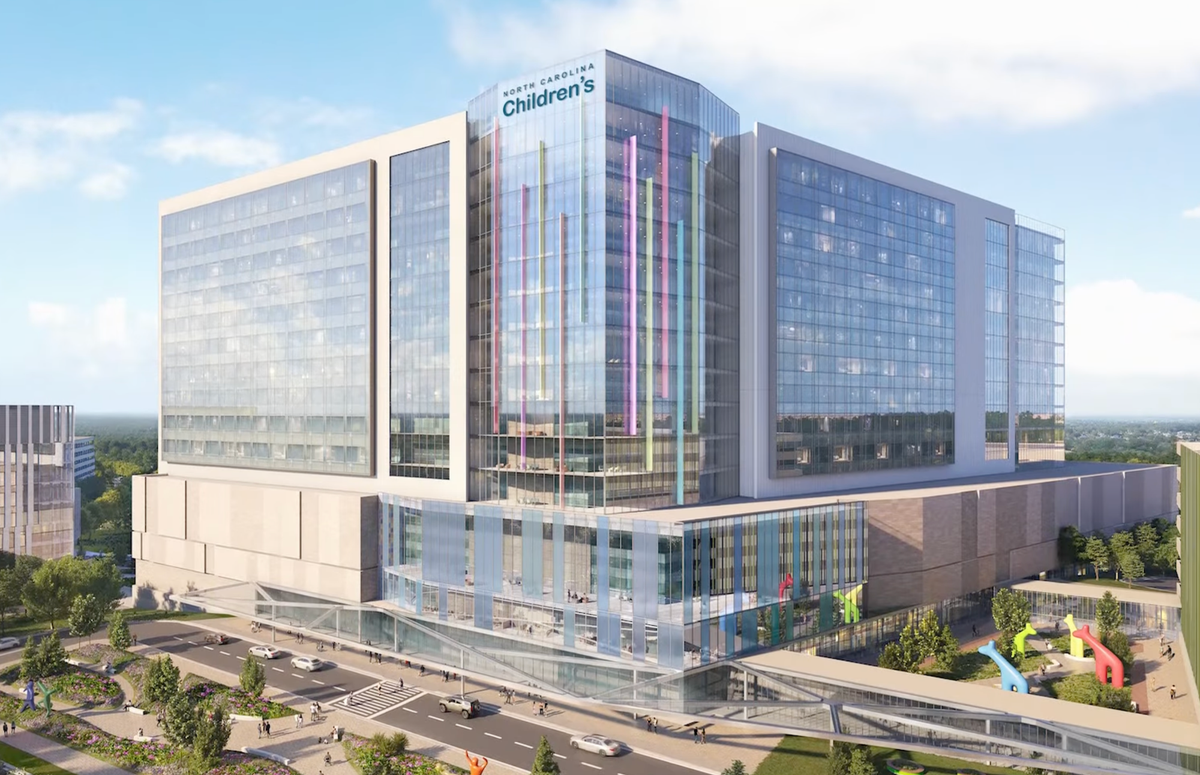
The North Carolina Children's Hospital coming to Apex is genuinely, unambiguously good for this town. It's a $3 billion investment. When complete, it will be the second-largest freestanding children's hospital in the United States. It's expected to bring approximately 5,000 permanent jobs and another 3,000 construction jobs during the build phase. North Carolina's Secretary of Commerce, Lee Lilly, called it "one of the largest economic projects in the state's history."
My son was born with a congenital heart defect called Tetralogy of Fallot. At four months old, he had to undergo open heart surgery which saved his life. The surgery was done at Riley Children's Hospital in Indianapolis - about 30 minutes from our home at the time. We were unbelievably fortunate and grateful to have the children's hospital in our backyard.
The July 10, 2025 press conference announcing Apex as the chosen site was a genuine win for this town. The transformative impact on healthcare access for families all across the Triangle is huge.
This story is not about whether the hospital should be in Apex. It should be.
This story is about what it took to get it here, who decided what to commit, and what residents were and were not told along the way.
The problem isn't the "what" - it's the "how"
Sometime in early to mid-2025, Town Manager Randy Vosburg began negotiating with North Carolina Children's Health, Inc. - a joint venture between UNC Health and Duke Health - to bring the project to Apex.
Those negotiations culminated in two letters signed by Vosburg on Town letterhead and addressed to Emily Ziegler at UNC Rex Healthcare.
The first letter is dated May 20, 2025. The second is dated June 25, 2025.
Together, those two letters commit the Town of Apex to approximately $61 million in support of the project:
- Approximately $45 million in water and sewer infrastructure
- An $8 million grant over 20 years (since restructured to $13 million — more on that later)
- Up to $5 million in fee reimbursements
- Two dedicated Town staff members valued at roughly $3.4 million over ten years
These commitments were made before any public Council vote authorizing them. They were made before residents knew anything was happening. They were made before the project was publicly announced.
Fifteen days after Vosburg signed the second letter, UNC Health publicly announced Apex as the chosen site. Several months later, NC Children's closed on the 230-acre parcel from RXR, the developer of Veridea. The reported land price was approximately $90 million.
The June 25, 2025 letter ends this way:
"We are happy to discuss these commitments at your convenience. I trust they display the continued and highest level of interest from Town leadership regarding Project LAW. We look forward to moving forward together."
Three things in those three sentences are worth pausing on.
First, Vosburg himself called what he was sending "commitments." Not a framework. Not preliminary discussion. Commitments.
Second, the phrase "highest level of interest from Town leadership." Vosburg was representing to UNC Rex that the Mayor and Council were on board, at the highest level, when he sent this letter. If that representation was accurate, then Council had given him authorization somewhere, somehow, before June 25, 2025. If the representation was not accurate, then he overstated Council's position to a counterparty that then relied on his representation to spend tens of millions of dollars.
Third, the closing line: "We look forward to moving forward together." That is the language of an agreement reached, not a negotiation in progress.
UNC Health received this letter and reasonably understood what it was. Two weeks later, they announced. Shortly after, they closed on the land.
Why this matters under state law
North Carolina General Statute 143-318.11 governs how local governments are allowed to use closed sessions. The relevant provision for this story is subsection (a)(4), which allows closed sessions for one specific purpose: to discuss the location or expansion of business activities in the area.
That's discussion. The statute permits Council to talk privately about economic development opportunities - to consider proposals, to debate trade-offs, to negotiate without revealing the Town's position to competing jurisdictions.
What the statute does not permit is approving commitments in closed session.
"Any action approving the signing of an economic development contract or commitment, or the action authorizing the payment of economic development expenditures, shall be taken in an open session."
Those have to happen in open session, with the public present, with public comment allowed, with each council member's vote recorded on the public record.
The reason for this distinction is obvious if you stop to think about it. Towns recruit businesses all the time. There are legitimate reasons for some of that work to happen privately. But the moment a town is going to commit public money - taxpayer dollars, ratepayer fees, infrastructure investments, staff time - that commitment has to be made in front of the people who are paying for it.
Otherwise, the residents whose money is being spent have no way to know what was promised, no opportunity to object, and no path to hold their elected officials accountable for the decision.
The statute exists precisely so that what appears to have happened in Apex - Vosburg signing letters committing the Town to approximately $61 million - cannot happen.
Even if it weren't the law...
Remember when Natelli proposed the data center? Residents organized. Council meetings filled up. The Environmental Advisory Board took it up. WRAL covered it extensively. The Town's own water resources director, Jonathan Jacobs, told reporters that the project's projected peak demand of 1 million gallons per day would equal roughly one-fifth of Apex's average daily water use.
That data center was going to use reclaimed wastewater - water that had already been treated, pulled from the regional plant, used for cooling, and largely returned. It would not have touched Apex's drinking water supply. The developer committed to paying for the infrastructure to deliver it.
Residents fought it anyway. The project withdrew.
The deal Vosburg made and the Memorandum of Understanding (MOU) council approved Tuesday commits Apex to deliver 1.7 million gallons per day of water to the new children's hospital. That's seventy percent more than the data center's peak demand. It's about one-third of Apex's current daily water use.
It's also drinking water - drawn from the same potable supply that serves residential and commercial customers - not reclaimed wastewater. And the Town, not the developer, is paying for the infrastructure to deliver it.
The MOU also commits Apex to 0.7 million gallons of sewer capacity per day for the hospital. The data center, because most of its cooling water either evaporated or returned to the wastewater plant, would have placed minimal additional load on the sewer system. The hospital's load is direct and continuous.
Don't get me wrong, I understand the difference between a children's hospital using a ton of water and a data center using a ton of water. My point isn't really about the water necessarily.
My point is... the data center generated months of public meetings, organized opposition, and detailed environmental review.
Two projects, in the same town, with the same water resources director, in the same year. One faced months of public scrutiny because residents knew about it. The other was approved in silence because they didn't.
That's what happens when the public is excluded from the process. It's not just that a law gets broken. It's that residents lose the ability to weigh decisions on the same terms they've already shown they care about. The system that protected this town from the data center was the same system that was bypassed for the hospital. The only difference is what residents got to see.
What it actually costs
The proposed FY26-27 budget - the one Vosburg presented on April 16, 2026, the same Vosburg who signed the $61 million in commitment letters - contains the following:
- Residential electric rates up 6.25%. The official explanation in the budget message is "rebuilding cash reserves." There is no mention of the Veridea System Expansion driving capital costs.
- Residential water rates up 4%. Sewer rates up 4%. Justified on cost recovery grounds.
- Wholesale water rates up 12.5%. Irrigation rates up 17%. Bulk water hookup fees up 66.7%.
- Property tax up $0.0354 per $100 of value — about $212 per year on a $600,000 home.
Behind those bills, the structural numbers are bigger:
- Operating fund transfer to water and sewer capital projects: up 143% ($1.8M to $4.4M)
- Capital Reimbursement Fee transfer to water and sewer capital projects: up 193% ($1.6M to $4.8M)
- General Fund Debt Service "Reserved for Future Expenditures": up 60% ($3.9M to $6.25M) - meaning the Town is building up debt service capacity for bonds that haven't been issued yet.
I read the full 13-page budget message Vosburg wrote to introduce this budget - the document specifically designed to explain to Council and the public what the major financial decisions of the year are.
It mentions the children's hospital exactly zero times.
The largest economic development commitment in the history of the Town of Apex - a deal Vosburg himself negotiated, signed letters for, and presented an MOU about thirteen days later — does not appear anywhere in the document explaining why your bills are going up.
Let me show you something even more striking.
I compared two versions of the Town's Capital Improvements Plan. The first was published in July 2025, right after Vosburg's letters were signed. The second was published with the FY26-27 budget two weeks ago.
In nine months, the total water and sewer capital plan grew from $115 million to $147 million. That's $32 million in new capital projects added to the plan in less than a year.
The biggest single jump is something called the Cary Subtotal - WWRWRF. That's Apex's share of expansion costs at the Western Wake Regional Water Reclamation Facility, which Apex co-owns with Cary. That line went from $36.1 million to $74.7 million in nine months - a $38.6 million increase.
Cary's own FY2026 budget - adopted last June - explicitly lists "Begin Updating the O&M Interlocal agreement with Apex" as a 2026 strategic initiative. The O&M Interlocal is the contract between the two towns that governs how they split costs at the joint facilities. Updating it now is consistent with one thing: Apex coming to Cary and saying we need more capacity to serve a major new user.
Cary's budget also notes that since 2020, Apex's daily sewage flows to the regional treatment plant have exceeded Cary's. Apex is now sending more sewage to the joint facility than Cary is, despite Cary having a larger population. That trend is accelerating. The hospital, committed to 1.7 million gallons of water per day and 0.7 million gallons of sewer per day, will accelerate it further.
None of this is labeled as NCCH-related anywhere in the budget. The cost is real. It's being paid. It's just not identified.
What they said Tuesday night
By Tuesday's meeting, Town leadership had a problem. They attempted to push it through the Consent Agenda with very little attention and no discussion. Fortunately, the MOU was pulled into a public hearing (at about 10:40pm) due to some public pressure.
Town Manager Vosburg opened the discussion with an introduction explaining the MOU and its history. That introduction is worth reading carefully, because in it he confirmed, in his own words, much of what the Town's procedural defense has tried to obscure.
He began with a casual line that turns out to matter:
"You've been teased on a couple of agendas in the past, but that was because we were still working through some of the additional details."
Translation: this MOU has appeared on prior Council agendas, then been pulled or modified, before its first public discussion. The April 14 placement that Council pulled is one example. Sounds like there were others. Each prior appearance was a moment when Council was likely in possession of the document and the public was not.
He then characterized the MOU itself:
"What you have before you is an MOU that's based on the discussions that we had with NC Children's during the site selection process. This is a formalization of those discussions into a memorandum of understanding."
The site selection process ran through the first half of 2025 - the same window during which Vosburg signed the May 20 and June 25, 2025 commitment letters. Vosburg is openly acknowledging that the MOU on Tuesday's agenda is a "formalization" of the same discussions that produced those letters. The substance of the deal was settled then. The MOU is the paperwork.
The Town's defense of the deal rests on the claim that nothing was binding until the MOU. The Town Manager just described the MOU as formalizing discussions whose results were committed in writing nearly a year earlier.
He went on:
"The proposed MOU stays within the original framework that was before you, and I'll kind of hit that first. Originally, we committed to or spoke about $8 million over 20 years, and then there was a $5 million [fee reimbursement] wrapped in that commitment, and there are some other details. Those were the biggest parts of the agreement..."
Watch the verb shifts. "We committed to or spoke about." He starts to say "committed," softens it, then a few sentences later refers to what existed before the MOU as a "commitment" and an "agreement." Vosburg, the person who signed the May/June 2025 letters, describes what those letters created using both of those words. Not framework. Not preliminary discussion. Commitment. Agreement.
He then explained why the financial structure was changed between the letters and the MOU:
"We also started to get into how we would plan for those fees and the timing... There were also discussions about which fees and how they would be reimbursed and we came to the conclusion that most of the fees that they would be waiving we would have to reimburse out of general fund dollars. So at the end of the day it all became a general fund discussion."
This is a meaningful disclosure. The original $5 million in fee reimbursements wasn't going to be a fee waiver. It was going to be a cash payment from Apex's general fund to NCCH - taxpayers' general fund money flowing directly to the hospital to make them whole on fees the Town had assessed. Rolling that $5 million into the $13 million amortized payment didn't eliminate the cost. It distributed it.
Vosburg explained the practical motivation:
"By putting it all together in one basket and then amortizing it over the 20 years, which equates to a six hundred and fifty thousand dollar annual commitment, we felt like that streamlined it - was more something we could depend on and budget for and plan for."
The candid version: amortizing the commitment makes it operationally manageable for the Town's budget cycle. It does not make it less expensive for taxpayers. The same dollars are paid. They are just paid in predictable annual slices instead of irregular lumps tied to NCCH's construction milestones. That predictability serves the Town's budget management. It also means no single year's budget shows a substantial NCCH-attributable expense - which is convenient for political messaging.
He then turned to the staffing commitments:
"There were some additional details related to staffing... One of those is the project coordinator... and the one that most recently came before you was an additional planner allocation related to the work in Veridea and the surrounding area and also for NC Children's. So those will be memorialized through the MOU process, but those two positions are already allocated and in place."
Read that again. The MOU obligates the Town to designate two dedicated staff members. Vosburg confirmed those positions are already filled and already paid for. The MOU is "memorializing" staff assignments that have already occurred.
That raises a specific question: when were those positions actually approved by Council, and were they identified as NCCH support positions at the time? Vosburg says one of them - the planner allocation - most recently came before Council, presumably as a budget item. If that allocation was approved without Council understanding it as part of an NCCH commitment, then the MOU's staffing terms were satisfied through positions Council approved under different framings. That's worth verifying through the budget record.
Then came the most consequential part of the introduction:
"There's also a reference in some of the documents we produced to the utility commitment, and that is a reference to in our CIP, I think it's somewhere 40 plus million dollars... As part of our discussions with NC Children's, we put that forward as a commitment for us towards this project and the surrounding area. That was already in place - council had invested in this area and in the overall basin - so there's a reference to that, but it won't be in the MOU."
Let me unpack what's in that paragraph.
First, Vosburg confirmed the existence of approximately $40 million or more in utility infrastructure commitments to the project. The $40 million matches CIP line items previously discussed in this article, including the increased Cary regional treatment expansion.
Second, he confirmed the Town "put that forward as a commitment" during negotiations with NCCH. Whatever the framing about basin-wide infrastructure, the $40 million was offered to NCCH as part of inducing the site selection. NCCH was told Apex would deliver this infrastructure. The fact that the infrastructure also serves other users in the basin doesn't change the fact that it was offered as commitment.
Third - and this is the line that defines the procedural problem - he confirmed that this $40+ million commitment "won't be in the MOU."
The Town's defense of the MOU rests entirely on the claim that the document is non-binding and therefore does not require open-session approval. That defense relies on the MOU being the operative commitment document. But Vosburg, in his introduction, told Council that the operative commitment document is incomplete - that approximately $40 million in commitments to NCCH exist outside it, by deliberate design.
Council was being asked to approve a framework that the Town Manager simultaneously confirmed does not contain the largest financial commitment in the deal. They voted yes anyway.
If any council member later defends the vote by saying they understood the MOU as the full deal, that defense is foreclosed by Vosburg's own statement. He told them in advance that $40 million was outside the document. They knew. They voted yes anyway. That's informed approval of an incomplete deal.
Vosburg also briefly disclosed something about the project's legal structure that hadn't been clear before:
"We learned from NC Children's and from the state that how the ownership of the land will be retained by the state, and that changes the entire inspection process so the Town of Apex won't be inspecting the facilities like we first thought."
Despite the reported $90 million land transaction between RXR and NC Children's, the underlying ownership structure apparently leaves the property in some form of state-retained status - sufficient to exempt it from local Town inspection authority. That changed Apex's anticipated revenue and oversight role mid-deal. Whether the state-retained ownership reflects how UNC Health and Duke Health hold property as state-affiliated systems, or some other arrangement, isn't clear from the public record. It's worth understanding, because it speaks to the actual legal status of what Apex is investing tens of millions to support.
Vosburg closed his introduction by handing off to Economic Development Director Joanna Helms to "talk about some of the economic benefits." That pivot from substantive disclosure to project celebration was rhetorically deliberate. Once the structural admissions were on the record, the rest of the meeting could focus on the project's positive impact rather than on the procedural questions the introduction had just raised.
Council members then offered their own framing.
Council Member Terry Mahaffey:
"People should be aware; this is not the first time we've seen this agreement. It's the first time we're discussing it publicly but this has been a lot of conversations, economic development, with council. We've been involved every step of the way... Council's been involved before the current council got here. We've been talking about this for a long time."
That involvement, Mahaffey acknowledged, occurred in private. The phrase "economic development with council" is municipal shorthand for closed sessions held under the (a)(4) exception of state open meetings law. The (a)(4) exception permits Council to discuss economic development matters in closed session. It does not permit Council to commit to economic development matters in closed session. Commitments must be approved in open session.
Tuesday, by Mahaffey's own description, was the first time the public was part of the conversation. Everything before it happened privately. That's the violation, told in Mahaffey's own words.
Council Member Ed Gray, defending the MOU's transparency:
"The brilliance of an MOU is that everyone gets to see the terms now. Everyone gets an opportunity to see what's there. And that is a great deal of access that the community gets in playing a role in this."
Gray made this statement defending the MOU's openness. It is contradicted directly by Vosburg's own statement, made minutes earlier, that approximately $40 million in commitments would not appear in the MOU. Both cannot be true. The community is not "getting to see the terms" if a substantial portion of the terms are deliberately omitted.
Gray also offered a defense of the process:
"First thing is let's demystify what this is. I mean, this project has been a conversation piece on council. I know it's been on many agenda, you know, as far as May of last year. And before then, this has been a topic of conversation. What this MOU does is this is just the memorialization and the next step in the larger process. This isn't some sinister plan to try to, you know, work behind anyone's back."
Read that quote and ask yourself: who was Gray responding to with that comment (which he said a second time again later)?
No one in the council chambers Tuesday night had accused him or anyone else of a "sinister plan" to "work behind anyone's back." The phrase appears nowhere in the meeting record before Gray uses it. It isn't a response to a question from another council member. It isn't a response to public comment. Was he responding to his conscience?
The structure of his defense is also worth examining. "This project has been a conversation piece on council... as far as May of last year. And before then, this has been a topic of conversation." Gray is making the same admission Mahaffey made: that Council has been involved in conversations about this project for nearly a year, in venues that were not public. By the time of Tuesday's meeting, this had been "on many agenda" - agendas that the public had no opportunity to weigh in on, because what Gray is referring to are closed sessions.
He frames the long history as evidence that nothing untoward happened. The opposite is closer to true. The longer Council was involved in private conversations about a $61 million commitment without an open-session vote authorizing it, the larger the procedural failure. Gray is offering, as exoneration, exactly the pattern that the open meetings law is designed to prevent.
"We're essentially telling Randy, go sign the document that we told you to go and sign when we do the MOU."
That phrase - "the document that we told [the Town Manager] to go and sign" - is a direct admission that Council had already directed Vosburg to enter into this commitment before Tuesday's vote. That direction was not given in any open-session vote in the public record. By Gray's own description, Tuesday's vote was a ratification of a decision that had already been made.
Each of these statements was offered in defense of the deal. None of them function as a defense. They are the strongest evidence on the record that the public was excluded from a process state law requires the public to be part of - while simultaneously gaslighting you into thinking you are a part of it.
Council Member Shane Reese took a different approach.
"Yeah, I was going to say this is an easy vote. I think it was, I agree that it wasn't necessary to pull from consent, but I appreciate it just for the opportunity to educate a little bit and talk about what this means."
Two phrases in those two sentences are worth pausing on.
"An easy vote." This was the first time the public had been part of the conversation about a $61 million commitment. It was the first opportunity for residents to be heard, for procedural questions to be raised, for council members to engage with arguments they hadn't already heard in private. By calling it an easy vote, Reese was confirming that his position was decided before any of those things happened. The public discussion did not factor into his decision because the decision was already made.
"It wasn't necessary to pull from consent." Multiple council members said versions of this. The implication is that placing a $61 million commitment, a 1.7 million gallon per day water dedication, a decade of staff commitments, and a 20-year grant on the consent agenda was procedurally appropriate. Consent is for routine, non-controversial items. Reese was saying the deal qualified.
Reese continued:
"And I will speak just for a second about from the taxpayer's perspective. To Joanna's point, this is the deal of a decade, if not more, right? I mean, this is other towns and cities would have loved for this to have happened because every dollar we're investing, we're getting much more out of it. And so that $650,000 over 20 years is going to pay dividends."
A few things worth noting.
Reese is speaking on behalf of taxpayers - not soliciting their input, but interpreting their interests for them. That framing is, in itself, the issue at the center of this entire story. The reason economic development commitments require open-session approval is because elected officials don't always know what taxpayers would conclude if given the chance to participate. Reese is bypassing that question by simply stating the conclusion.
He cites the cost as "$650,000 over 20 years." That's the annual amortized payment, not the total commitment. The actual commitment is at least $61 million when you include the original letter terms - and substantially more when you include the $40+ million in utility infrastructure that Vosburg confirmed exists outside the MOU. By citing the smallest defensible number, Reese makes the deal sound modest. The math supporting the framing is the same math that animated the amortization structure in the first place: distribute the cost across enough fiscal years that no single budget shows a substantial NCCH-attributable expense.
He closes by thanking Vosburg for his work on the deal:
"So thank you for all your hard work and thank you for your hard work, Manager Vosburg and to all staff."
The thank-you is unqualified. There is no acknowledgment that the procedural path Vosburg took - making $61 million in commitments without an open-session Council vote - might warrant scrutiny. There is no separation of substantive from procedural evaluation. Whatever Vosburg did, however he did it, Reese is grateful for it.
In the deliberative process state law contemplates, Council members evaluate staff work product critically. They may thank staff for effort while questioning choices. They may find work satisfactory but the process problematic. None of that happened Tuesday night.
Council Member Sue Mu was the most direct.
Mu was one of two council members who took office in December 2025 - meaning she joined Council after Vosburg's letters were signed, after the public announcement, and after the land deal was finalizing. She described her relationship to the deal candidly:
"This children's hospital [project was] approved during my campaign. I had not become the council yet, but I remember I was so excited, really, when I read the news and learn about it."
For Mu and Reese who joined in December, the hospital deal was effectively settled. They learned about it as news during their campaigns. They did not participate in the closed sessions where Mahaffey says Council was "involved every step of the way." Their first opportunity to vote on the matter was Tuesday - when the only meaningful options were to approve the framework that had been negotiated in their absence, or to become the council members who killed the children's hospital deal.
Mu acknowledged the constraint plainly:
"This MOU, just to make it clear, everybody, you have to do this, we have to do this, we all agree with this..."
"You have to do this. We have to do this." It is the most direct admission of the meeting that Tuesday's vote was not a deliberation. It was an obligation. The substantive decision had been made elsewhere. The Council was being asked to ratify a commitment that had already become unavoidable.
This is the structural problem the open meetings law is designed to prevent. N.C.G.S. § 143-318.11(a)(4) requires open-session approval of economic development commitments precisely so that Council's vote occurs before the commitment becomes unavoidable. By the time Mu and her colleagues voted on Tuesday, the deal had been in motion for over a year - UNC Health had purchased the land, two Town staff had been assigned, the capital plan had been revised, and the Town Manager had publicly committed Apex to the project. "No" was no longer a real option. The vote was a formality.
Mu's directness is itself illuminating. She isn't pretending Tuesday's vote was deliberative. She's celebrating the project and acknowledging the obligation to ratify the commitment. Whether or not she intended that admission, it confirms what the procedural record had already suggested: by April 28, 2026, the only thing left for the public to influence was whether to applaud.
What about "non-binding"?
The Town's last line of defense, which several council members reached for Tuesday night, is that the MOU is non-binding by its own terms - so no real commitment has been made until a future contract is signed.
There's a problem with that defense, and it's visible in the actions the Town has already taken.
The University of North Carolina Health Care System has already purchased the 230-acre hospital site. That land deal was closed based on Vosburg's letters. UNC Health doesn't acquire $90 million in land based on aspirational discussions. They acquired it because they had written commitments to rely on.
Two Town of Apex staff members have already been assigned to support the project. Vosburg confirmed this on the record Tuesday: "those two positions are already allocated and in place." How long they have been allocated, and how much taxpayer money has been spent compensating them for work supporting a project that was never publicly authorized, is unclear.
The Town's Capital Improvements Plan has already been revised to add $32 million in water and sewer projects, the bulk of which align with the hospital's capacity needs.
The proposed FY26-27 budget has already been built around the rate and tax increases necessary to fund the infrastructure.
The public announcement was made on July 10, 2025, with the State Secretary of Commerce in attendance.
If this MOU is truly non-binding, the question is simple: why has the Town already taken every action it would take if it were binding?
The honest answer is that the deal is binding. Not legally, in the sense of an enforceable contract. But practically, in the sense that all of the actions that would normally follow a deal have already happened. The MOU is the public-facing document. The actual commitment was made about ten months earlier, in writing, by the Town Manager, on Town letterhead, to a counterparty that has since spent tens of millions of dollars in reliance on it.
There's a related question the Town's defense doesn't address: did Tuesday's MOU vote actually satisfy the statutory requirement that economic development commitments be approved in open session?
The (a)(4) statute is specific. "Any action approving the signing of an economic development contract or commitment, or the action authorizing the payment of economic development expenditures, shall be taken in an open session."
Tuesday's vote was in open session. So at first glance, it might appear to check the box.
But the Town's own defense of the MOU is that it's non-binding - that it doesn't create commitments and doesn't obligate funds. If that's true, then Tuesday's vote can't have been an "action approving the signing of an economic development contract or commitment," because by the Town's own characterization, no contract or commitment was being signed. The Town cannot simultaneously argue that the MOU is non-binding (so it doesn't create new obligations) and that Tuesday's vote satisfied the open-session requirement for approving commitments. Those two positions cancel each other out.
Meanwhile, the actual commitments - the ones that produced UNC Health's land purchase, the staff assignments, the capital plan revisions, and the budget structure - were made ten months earlier in Vosburg's letters. Those commitments did not receive open-session approval before they were made. Tuesday's vote occurred after the consequences were already in motion.
So why does the MOU exist?
In my observation, I believe it serves three purposes. It creates a public-facing document that gives the Town an artifact to point to when asked what Council approved. It establishes a framework for the future binding contracts that will actually obligate the dollars. And it provides an open-session vote that the Town can later cite as evidence of (a)(4) compliance - even though, by the Town's own description, the document being voted on doesn't commit anything.
That last function is the most revealing. The MOU was on the agenda Tuesday in part because the Town needed a vote it could point to. The deal had been made privately, the consequences were already in motion, and the absence of any record was itself a problem that needed to be solved. Voting on a non-binding framework - and calling that vote "approval" - was the solution.
Whether that solution actually satisfies the statute is a question for lawyers and possibly for courts. But the structural reality is hard to miss: the public's first opportunity to vote on this deal occurred ten months after the deal had already happened, on a document the Town simultaneously claims doesn't commit anything.
What now?
The MOU passed Tuesday. UNC Health already owns the land. Two Town staff members are already assigned. The infrastructure is already in the capital plan. The rate increases that fund it are already in the proposed budget. The deal, as a practical matter, is done.
There is no version of this story that ends with "and so the Town reversed course and the project went elsewhere." That isn't going to happen. It isn't, on balance, what most residents would want even if it were possible.
But the deal is not the only thing at stake here. The system that produced this deal is still in place.
Right now, in Apex, the Town Manager can negotiate tens of millions of dollars in commitments without Council voting on them in open session. Council members can be involved in decisions through closed-session conversations the public never sees. Major projects will be placed on the consent agenda where they try to pass without discussion. The Town's chief executive can write a 13-page budget message that does not mention the largest economic development commitment in Town history. The bills you pay can fund deals you were never told about.
Each of those things happened with this hospital. Each of them is procedurally normal in the Town's current operating culture. Which means each of them can happen again. The next major deal is already somewhere in the pipeline. Maybe it's another anchor employer. Maybe it's another major development. Maybe it's another infrastructure commitment. Whatever it is, it can be made the same way this one was - unless residents make this one cost something.
That cost doesn't have to be the deal itself. It can be holding our elected representatives accountable. It can be calling for the Town Manager to act with transparency rather than just saying the word transparent periodically. It can be a change in the Town's operating procedures, a stricter Council policy on closed-session use...
Or it can be nothing. The Town can ride out a few weeks of bad press and go back to operating exactly as it was. That's the most likely outcome. It's what happened when Mahaffey lied and defamed me to cover up a data leak. It's what happened with the anonymous NDA. This isn't political. This isn't about the hospital. It's about a huge economic commitment done behind closed doors, the impact on your taxes and bills that you had no say in, and a council who is telling you that it's fine.
That framing is what they were selling Tuesday night. Whether it works depends on whether you buy it.
Ask yourself a single question: would you have wanted to be part of this decision before it was made?
If your answer is yes - if you think a $61 million commitment, a 1.7 million gallon per day water dedication, a 20-year grant obligation, and a major reshaping of the Town's capital plan are the kinds of decisions you should have a chance to weigh in on - then the only acceptable answer is for the people who decided you didn't need to be part of the decision to be held accountable.
What we do now decides whether the next deal can happen the same way.
If you have information that should be part of this story - emails, documents, conversations, anything - feel free to reach out to adam@thepeakweekly.com. Anonymity is respected.
The Peak Weekly exists, completely free of cost and free of ads, because there isn't another local outlet doing this kind of reporting. If you found this useful, please forward it to one neighbor.