The Secret NDA, A Staged Presentation, and the Playbook Behind Apex's Data Center
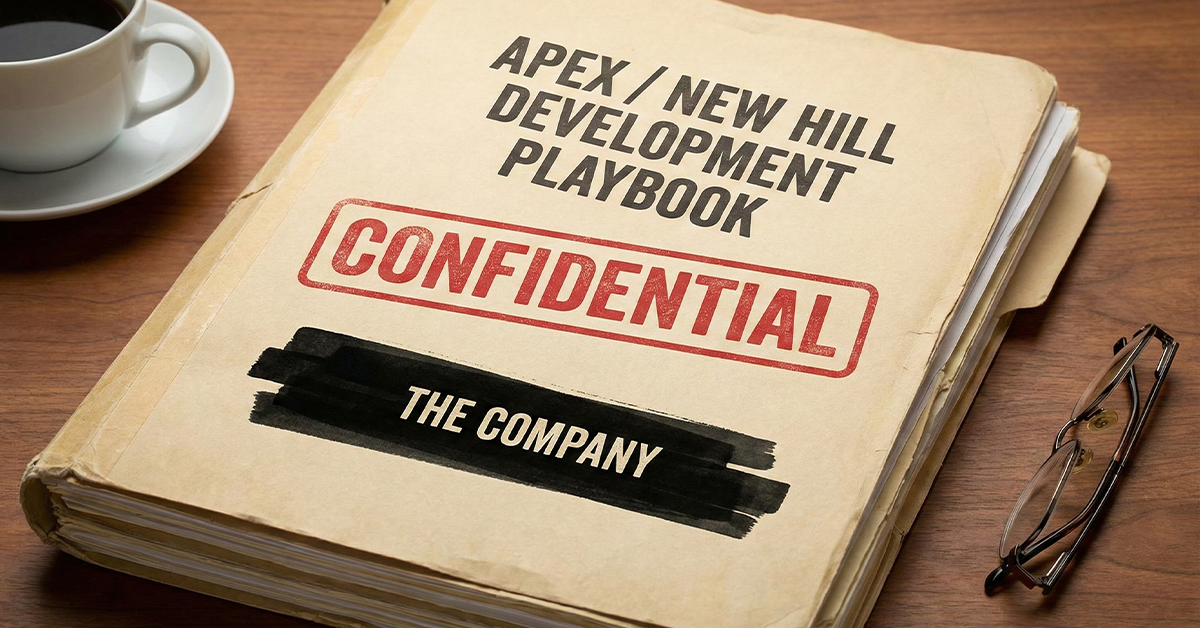
This is an investigative analysis by The Peak Weekly based on publicly obtained municipal filings and record responses. Town officials have not disclosed the corporate party to the Town Manager's nondisclosure agreement. The agreement itself refers to the other party only as 'The Company,' and a public records request seeking the identity remains unanswered. Where the public record does not provide direct confirmation, this report uses pattern analysis and comparative research from other jurisdictions to identify the likely parties involved. Where this article draws conclusions, it is my analysis of the public record. I have made an honest effort to distinguish between documented fact and reasoned inference. If any party named here believes something is inaccurately represented, I welcome a response for immediate review and correction.
Edit March 6, 2025: 11 days after publishing this article and 15 days since filing a public records request for the identity of "The Company" in the NDA, Natelli Investments has officially withdrawn their application and scrapped the data center project. A response to my records request is still pending.
In this article, I will show you:
- The evidence that Amazon is the data center's end-user.
- Why they didn't want you to know that.
- The staff's data center "research" presentation was compromised.
- Terry Mahaffey's video is for Natelli - not for you.
- Amazon's own paper trail in other states reveals the playbook.
- The Mayor met with Natelli, and Natelli wanted more.
- What will actually stop this (and it's not complaining about sound and water).
The Evidence Identifies Amazon as the End-User
When I first shared the nondisclosure agreement that Town Manager Randy Vosburg signed on December 1, 2025, I told you there were things about it that didn't add up like the fact that he was agreeing to destroy public records upon Amazon's request, which appears inconsistent with North Carolina Law NCGS 132-3. Also unusual: the agreement never names the other party. Throughout the entire document, the other party is referred to only as "The Company". No name. No corporate address. No identifying information.
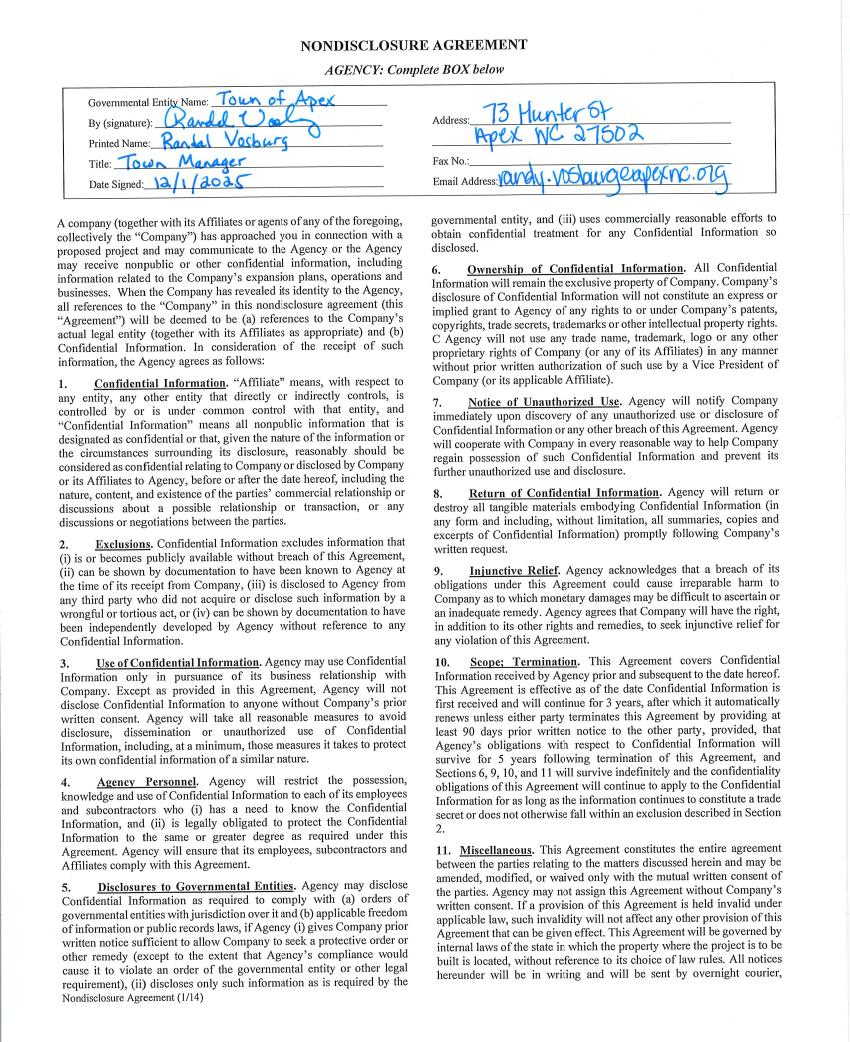
The question remains - who is, "The Company"?
The evidence overwhelmingly points to one company: Amazon.
The Town has not yet stated this publicly. However, my pending public records request from 2/18/2026 asks them to do exactly that - and under N.C.G.S. § 132-1, the identity of a party to a government agreement isn't something a private contract can keep secret, even though they tried.
But, as you'll see, public records from other jurisdictions have already said it for them.
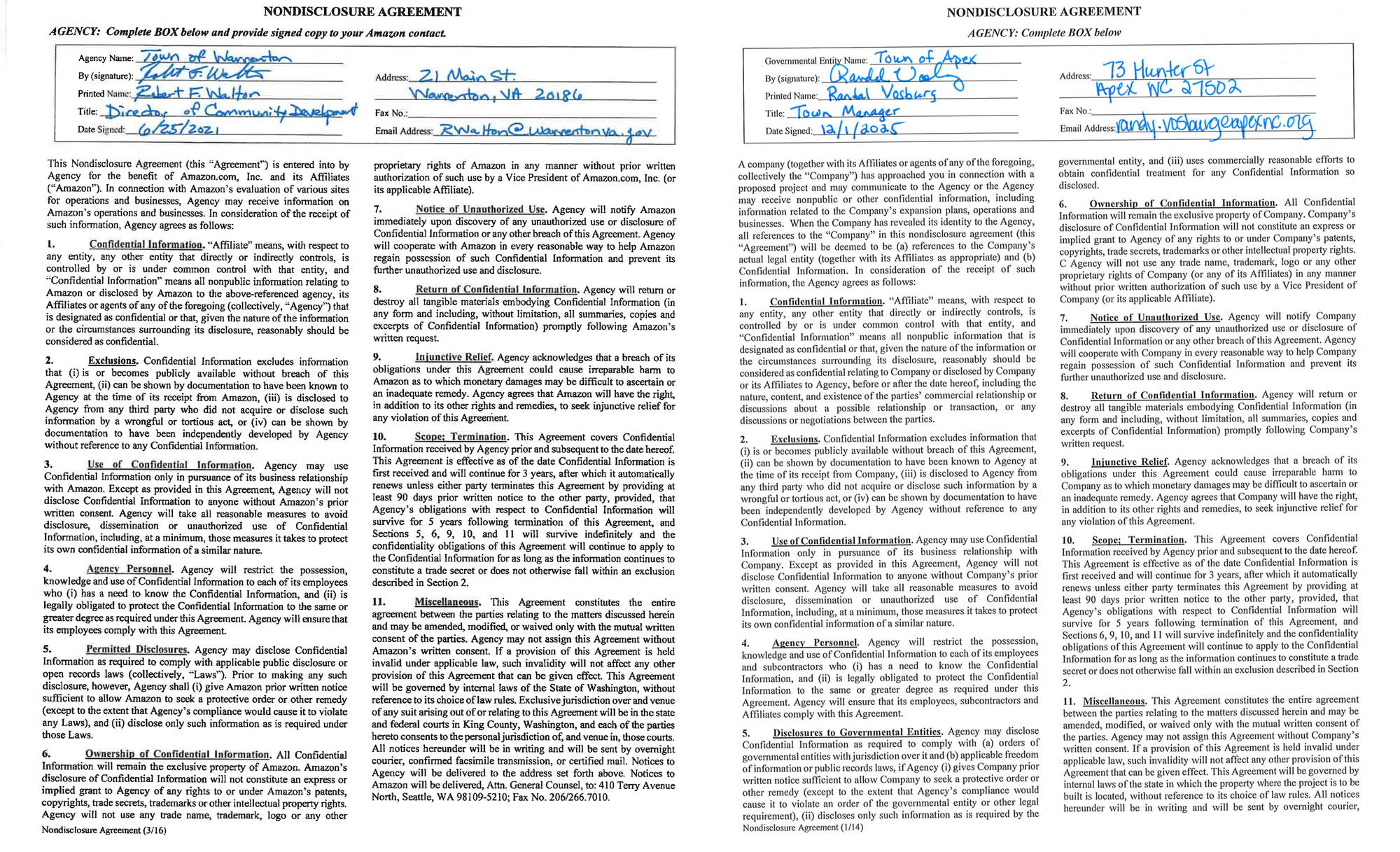
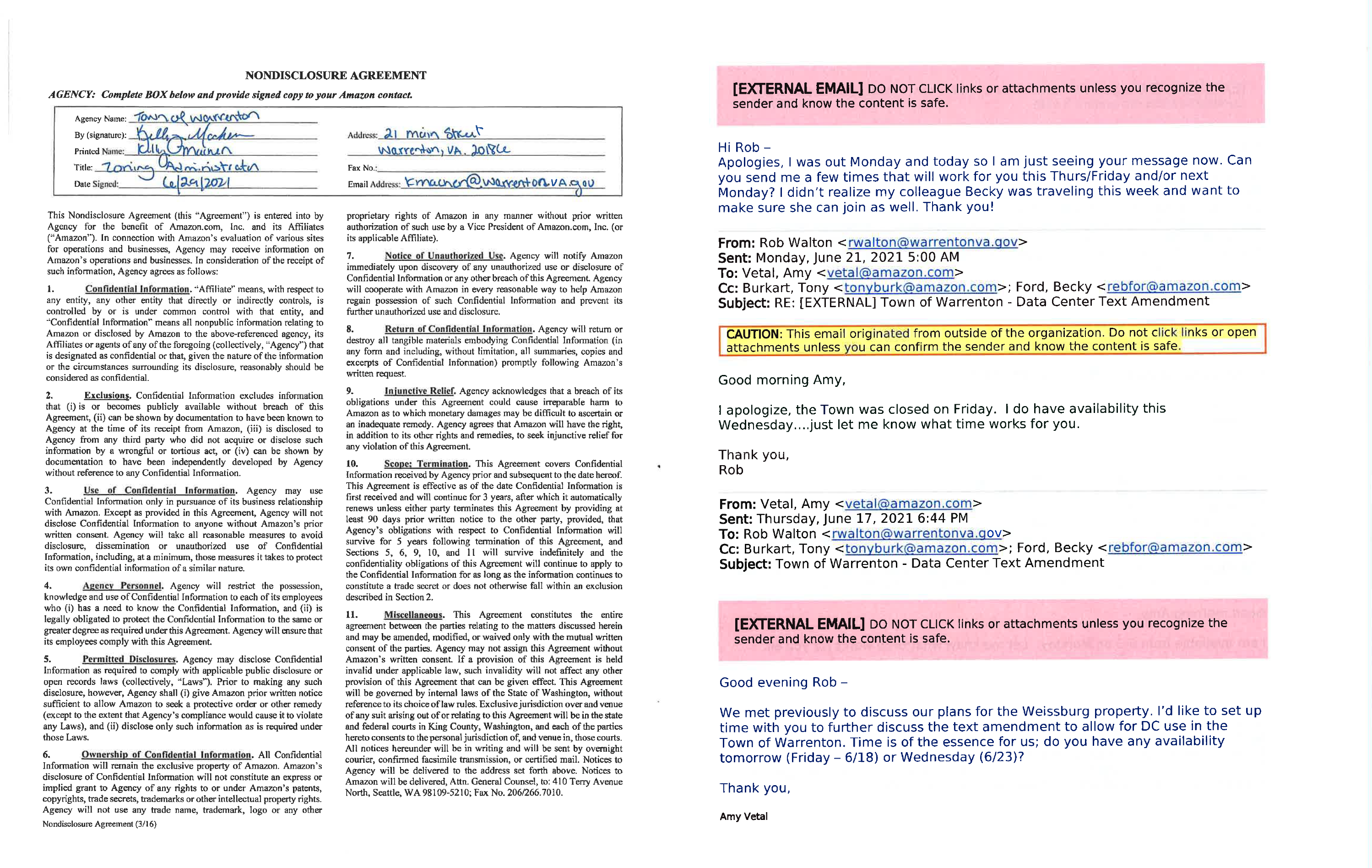
On the Left: Town of Warrenton, VA NDA with Amazon. On the Right: Apex NDA with "The Company".
In Warrenton, VA, an NDA was signed that specifically stated the other party was Amazon which is almost word-for-word the same as Apex's NDA with an undisclosed party.
But I get it. One example could be a coincidence. So here's two more in two other towns with Amazon NDA's:
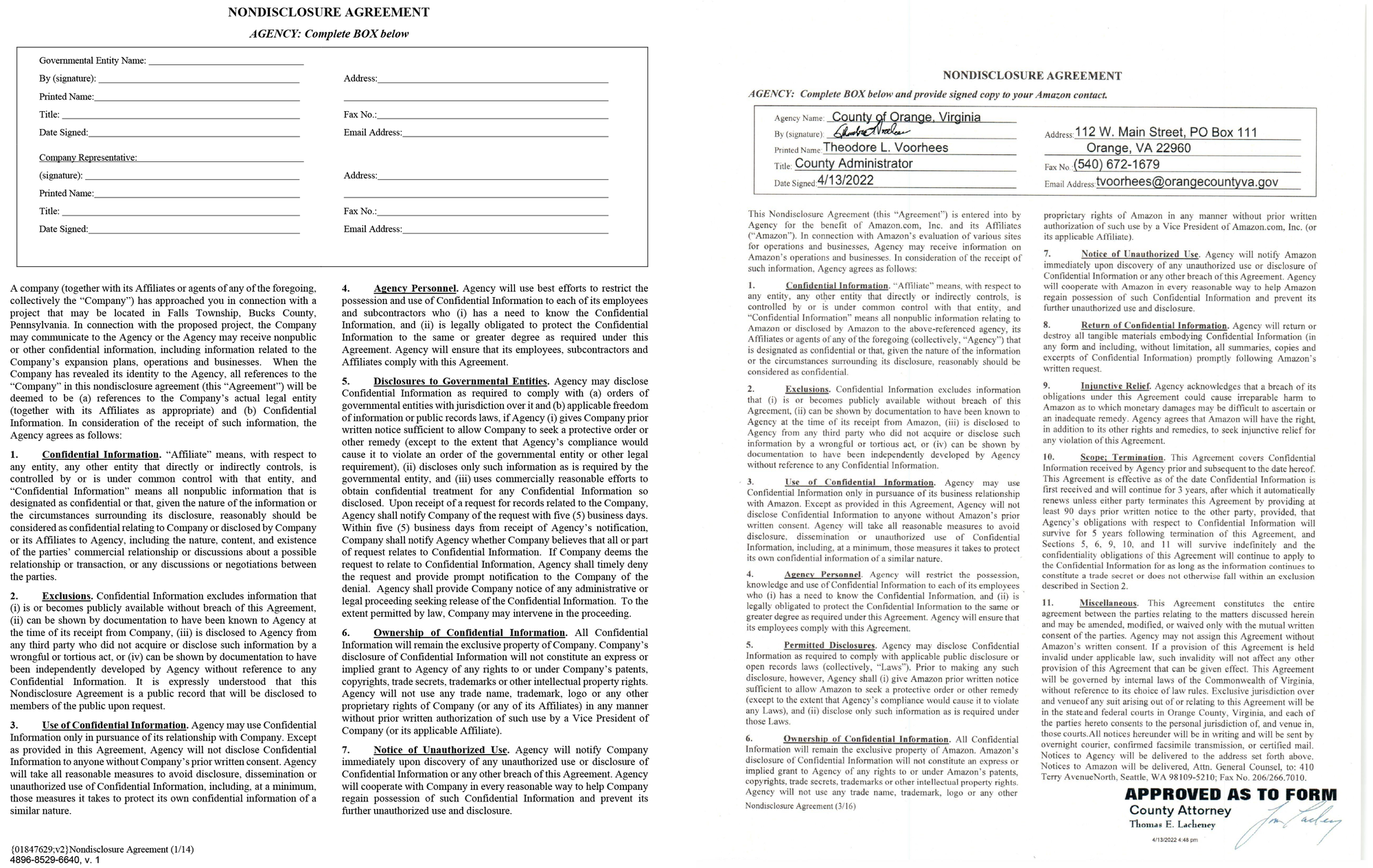
On the Left: Falls Township (PA) NDA with Amazon. On the Right: Orange County, VA's NDA with Amazon.
The confidentiality obligations, the definition of Confidential Information, the term and termination language, and the governing structure are functionally identical across all four agreements.
Each was executed between a municipal government and Amazon in connection with a proposed land use action - specifically, data center development requiring zoning or rezoning approval.
Why They Tried to Keep This Secret
On paper, it shouldn't matter who the end user is. The UDO framework is the same. The noise standards are the same. The application either meets the requirements or it doesn't. The identity of the company operating the facility doesn't change the decibel level at the property line.
But that's on paper. In reality, it changes everything.
There is a massive difference between a council member voting to approve "a data storage facility proposed by Natelli Investments that meets our adopted standards" and voting to approve "Amazon's data center." The first is a technical land use decision. Controversial, for sure. But there's a plan to handle that.
The second is a political choice. It's a vote for or against a trillion-dollar corporation, cast on camera, in front of constituents who have now heard the name and have an opinion about it. That vote follows you into your next election. Your opponent puts it on a flyer. Reporters ask you about it. Residents who never attended a planning meeting in their lives suddenly have something to say.
This isn't hypothetical. It's exactly what happened in other municipalities when Amazon was identified.
In Warrenton, VA, voters removed every council member who voted to approve the project. In Orange County, VA, national organizations joined the lawsuit. In community after community, the moment Amazon's name was attached to a data center proposal, the political cost of a yes vote skyrocketed. The projects that had been gliding through technical review became front-page controversies overnight.
Amazon learned from that. And the lesson wasn't to stop building data centers. It was stop letting people know it's Amazon until it's too late to matter.
That's what every piece of the Apex operation is designed to do. The NDA says "The Company" instead of Amazon. Natelli's name is on the application, not Amazon's. The UDO framework is presented as general policy, not Amazon-specific regulatory capture. Every layer of this process exists to keep one name out of the conversation for as long as possible.
The Data Center Research Presentation Was Calculated & Compromised
On January 22 & 29, 2026, the Apex Town Council & Planning Board held a joint work session on data centers. Town staff presented research on data center impacts: noise, water use, power demand, cooling systems, etc - and recommended a set of standards that could be added to the Unified Development Ordinance (UDO).
As Council Member Terry Mahaffey says, who credits himself with initiating this staff research project:
"One of the things that happened early on is I had asked staff to put together a work session to talk about what the use is gonna be - kind of do some independent research to put together some rules... and I thought it was a good idea for Apex to develop some."
If you watched that resulting staff research presentation, it probably looked like your local government doing its homework: staff studying an emerging land use issue, presenting findings, recommending a policy framework. Responsible governance.
But let's be clear. By no reasonable definition was this research and presentation "independent". The research was conducted by Vosburg and his staff. Vosburg has a documented career history of facilitating data center approvals in Stafford County using a similar regulatory-framework-first approach.
And, Vosburg signed that NDA 52 days prior to this work session.
Vosburg was under a confidentiality agreement with 'The Company' while simultaneously controlling the research that would shape the regulatory pathway for that project.
Telling Apex residents that this was "independent research" is an insult.
But it gets worse when you look at how the research was conducted. The presentation wasn't neutral findings; it went well beyond research and explicitly recommended that Council "finalize amendments" to create data center definitions and standards based on the recommendations staff made. That's a policy recommendation, not research.
When Apex faces a significant policy question, the standard practice is to hire an outside consultant. The town has done this repeatedly - for a utility billing audit, for transportation studies, parks master plans, comprehensive land use updates...
For something of this magnitude, you bring in a firm with subject matter expertise, professional independence, and no stake in the outcome. They survey comparable municipalities, interview stakeholders, study impacts both positive and negative, and present a range of options. Their findings carry weight precisely because they're independent.
That didn't happen here. The single biggest proposed land use change in Apex - an industrial use that would consume enormous amounts of power and water, generate continuous noise, and fundamentally alter the character of surrounding neighborhoods - was studied internally by the same staff whose boss is under a confidentiality agreement with the end-user of the project seeking approval.
Think about what an outside consultant would have done differently. They'd survey communities where data centers already operate and report what those residents actually experience. They'd present a range of policy options, including options that might restrict data centers in ways that make the proposed site unworkable. Their findings might not support what the developer and/or end-user needs. They might recommend setbacks too large for the parcel, or noise limits too strict for the equipment, or water usage caps that don't pencil out at hyperscale.
By keeping the research in-house, Vosburg avoided all of that. He controlled the inputs, the analysis, the framing, and the recommendation. And when you look at what staff actually recommended, the alignment with what a hyperscale operator like Amazon needs is remarkable.
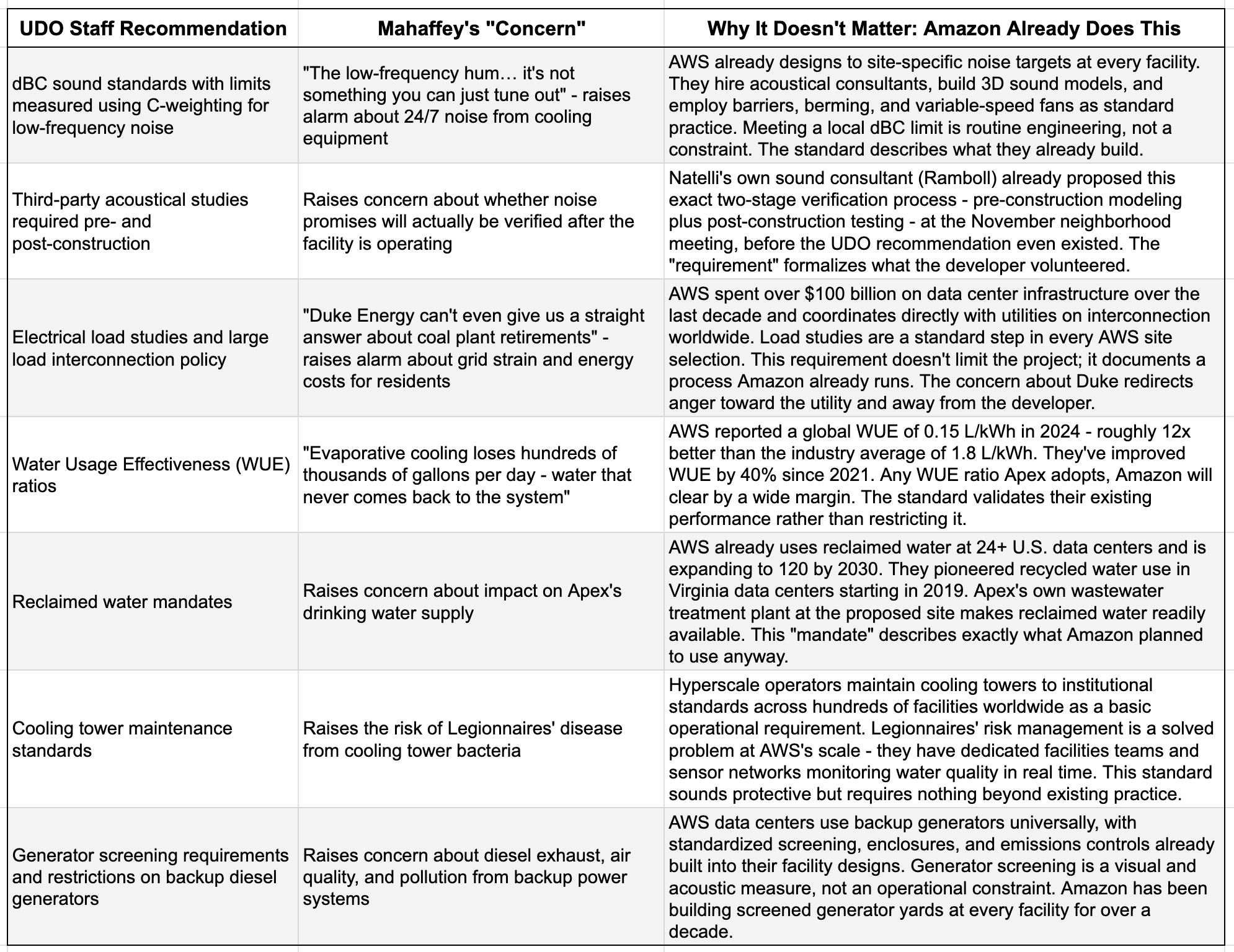
The proposed UDO standards include noise limits measured in dBC - a weighting scale that emphasizes low-frequency sound, which is exactly the type of noise data centers produce. They include Water Usage Effectiveness ratios and reclaimed water mandates - metrics that hyperscale operators already track and optimize for. They include electrical load studies and cooling tower maintenance standards. They include generator screening requirements and third-party acoustical studies.
Every single one of these standards sounds protective. That's the point. They're designed to sound like safeguards while actually describing operational practices that companies like Amazon already follow at their existing facilities. The framework doesn't restrict a hyperscale data center. It describes one.
Here's what I mean. I'll use Diesel Generators / Air Quality as an example:
- Mahaffey's blog states, "I’m concerned about the exhaust from hundreds and hundreds of diesel generators running at once in an area near a residential zone or a school."
- Town staff's presentation (page 104) recommends Tier IV or Tier IV equivalent generators and notes that it's the EPA's strictest standards.
- Natelli's FAQ states, "The backup generators will be manufactured to meet EPA Tier 4 standards, which require modern pollution-control technologies, such as particulate filters, that significantly reduce emissions."
Now read those steps in reverse, which is the actual order of events:
Natelli commits to Tier IV on their website before the work session ever happens. Staff recommends Tier IV in the presentation. Mahaffey raises diesel exhaust as a concern in his video weeks later. The "concern" was raised after the solution already existed. The "strict standard" was recommended after the developer had already committed to meeting it.
So what happens next? UDO amendment with that strict standard gets approved, Natelli refiles meeting that strict standard like they'd planned all along, Mahaffey is pleased that they met their strict standard. Data center approved.
Before anything moves forward - the UDO Amendment, the rezoning vote, any of it - the Town of Apex owes the community true, independent, uncompromised research and recommendations.
Terry Mahaffey's Video Update Does Exactly What the Playbook Requires
On February 19, Mayor Pro Tem Terry Mahaffey posted a video update and accompanying blog post about data centers in Apex. If you watched it, you probably came away thinking Terry Mahaffey is fighting for you.
He raises every concern you'd want a council member to raise - power grid strain, noise, water evaporation, Legionnaires' disease risk from cooling towers, diesel generator pollution. He calls out Duke Energy for being inconsistent about coal plant retirements. He says he's "not willing to approve any project anywhere that doesn't meet the strictest standards."
It's a convincing performance.
Go back and watch it again, but this time, open the January 22 work session materials in another tab. Pull up the UDO framework that staff recommended. Then compare.
Every single concern Mahaffey raises in his video has a pre-built answer waiting in the UDO framework.
He raises power grid strain: the framework includes electrical load studies and a large load interconnection policy. He raises noise: the framework includes dBC sound standards and requirements for third-party acoustical studies. He raises Legionnaires' disease: the framework includes cooling tower maintenance standards. He raises water evaporation: the framework includes Water Usage Effectiveness ratios and reclaimed water mandates. He raises generator pollution: the framework includes generator restrictions and screening requirements.
He's not sounding an alarm. He's raising concerns to which a solution is already waiting in the UDO framework that staff produced under Vosburg's direction, and presenting each item back to you as if it's a concern he's just now discovering.
Every section lands at the same destination: pass the UDO framework.
Listen carefully to how he frames his position. He doesn't say he'll oppose a data center. He says he won't approve one "that doesn't meet the strictest standards that Apex will be putting in place in the coming months." That's not opposition. That's a pre-commitment. The moment those standards are adopted and a developer checks every box - which a hyperscale operator like Amazon already does - Mahaffey has already told you he's voting yes.
His exchange with Duke Energy is the same move. He catches Duke being inconsistent about coal plant retirements, calls it "completely unacceptable." Great soundbite. Makes him look tough and independent. But think about what it actually accomplishes: it redirects your anger away from the data center developer and end-user toward the utility company. Duke becomes the villain.
Apex has no jurisdiction over Duke Energy's regional grid, rate cases, coal plant retirements, or capacity planning. Those are NC Utilities Commission matters. The Town literally cannot write a UDO rule that says "this project shall not cause rate increases" or "this project shall not delay coal plant retirements." They don't have that authority.
So Mahaffey's performance becomes even clearer: he's loudly raising the one concern - grid strain, rate hikes, coal plant delays - that the Town cannot address through the UDO. He gets to sound outraged about something he knows the local regulations will never touch. Then when the vote comes, the argument presumably is something like: "We put in strong regulations on noise, setbacks, water, and air quality. The power grid issues are Duke's responsibility and the Utilities Commission's jurisdiction, not ours. We did everything within our authority."
It's the perfect escape hatch.
And then there's this line: "Perhaps starting with a huge data center isn't a great idea" and that he'd "like to start smaller." That sounds cautious. It's not.
Likely, in some form, the Natelli application will come back scaled down from the original proposal. Perhaps literally scaled down. Or, more likely, scaled down in the form of building it out in phases. And no, I don't think that Mahaffey is predicting the future when he says this. I think he's helping write it.
Mahaffey has already built the public narrative for why he can support it. "I told you I wanted smaller, and that's what they're proposing." Developer concedes on scale, Mahaffey claims a win for the community, project gets approved.
The Proof: Warrenton, VA; Orange County, VA; Falls Township, PA; King George County, VA
I'm not asking you to take my word for any of this. What follows is the public record from four municipalities that went through this process before Apex. Each one signed NDAs with Amazon for data center projects. Each one left a paper trail.
And when you line them up in sequence, what you're looking at isn't four separate stories. It's what appears to be a playbook - refined and repeated, with Apex as the latest and most sophisticated version.
Warrenton, Virginia (2021)
In 2021, the Town of Warrenton began working with Amazon on a data center project. The sequence went like this:
Town staff signed NDAs first. Then Amazon conducted individual one-on-one meetings with each council member and planning commissioner over a two-day period, July 14 and 15, 2021. Not a group briefing. Not a public session. Individual meetings, scheduled separately, so that at no point did a quorum of the governing body discuss the project together in a setting that would trigger Virginia's open meetings requirements.
Before the specific project came to a vote, Warrenton pursued a text amendment to its zoning ordinance, updating the code to define and accommodate data center uses. The text amendment went first. The site-specific application followed. That ordering matters, and I'll explain why when we get to Apex.
When council member William Semple was later asked about the NDA, he said he "honestly didn't remember signing any such agreement." That's not someone who carefully weighed a legal obligation to a trillion-dollar corporation. That's someone who was walked through a process designed to feel routine.
Important timeline on this data center:
- In February 2023, the town council voted 4-3 to approve the 220,000-square-foot facility despite immense community opposition.
- In 2024, residents voted out all council members who supported the project. The incoming council pledged to re-examine the project and to ban future data centers.
- On July 11, 2025, the Warrenton Town Council voted 6-0 to remove data centers as a permitted use in industrial zones, effectively halting new proposals.
- While the 2025 ban does not explicitly revoke the prior 2023 approval for the Blackwell Road site, the new, unanimously opposed council and restrictive zoning changes, along with the controversy including lawsuits regarding withheld public records and FOIA requests, have put the project's future in doubt.
- 3 years since being approved, construction on this data center project has been stalled and has not even started.
Orange County, Virginia (2022)
Orange County is where the paper trail is most complete, because the county is now in litigation and the documents have been exposed through that process.
Between March and August of 2022, ten Orange County officials signed NDAs with Amazon.com Services LLC for a project called Wilderness Crossing. The sequence of signatories tells you everything about how this works:
The County Administrator and the Economic Development Director signed first - the staff who control information flow to elected officials. Then individual members of the Board of Supervisors were brought in one by one over the following months. Then planning staff who would process the application. Then the utility.
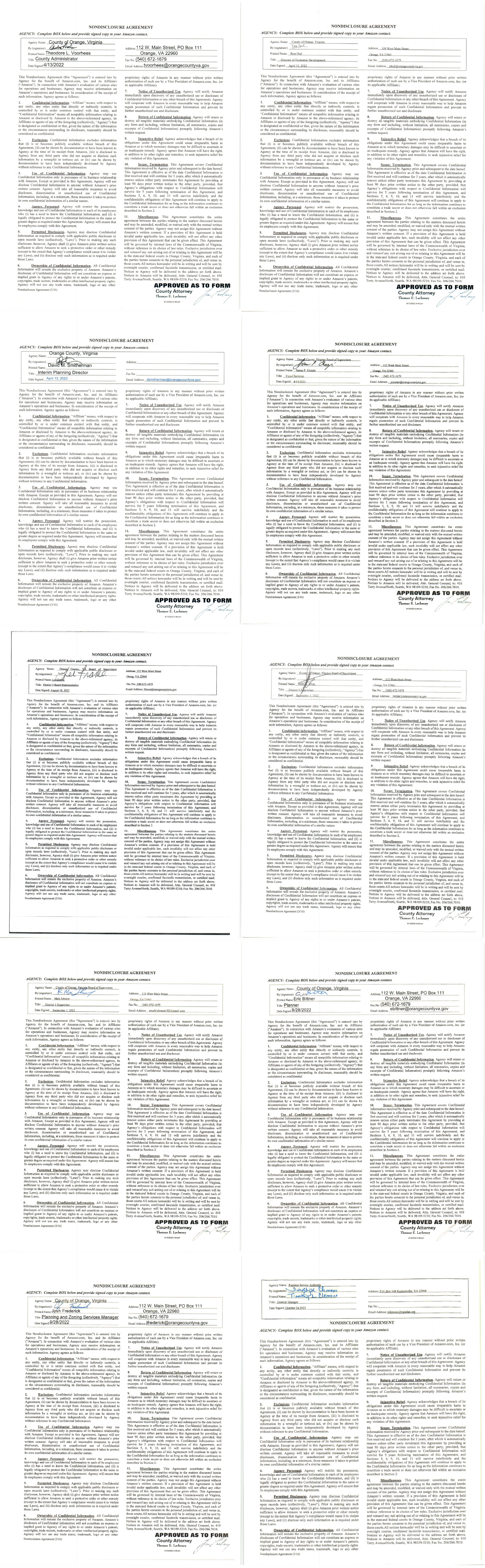
By the time the rezoning vote happened, a majority of the Board had been individually briefed under NDA. They never deliberated together in public before voting. Each one received the same information in a private setting and arrived at the public hearing with their position already formed. The public hearing - the one part of the process where residents actually get to speak - was a formality. The votes were locked before anyone stepped to the podium.
The project was approved in 2023, but like Warrenton, this Amazon data center has also been stalled. Most recently, in September 2025, a judge ruled that a major lawsuit filed by the American Battlefield Trust and local residents could proceed to trial. The suit seeks to overturn the rezoning, arguing that the Board of Supervisors committed procedural errors and ignored state law when they approved the "mega-development".
Falls Township, Pennsylvania (2024)
Let's do a quick check-in on where we are at right now. Two data center projects. Both Amazon. Both with the same Amazon NDA. Both stalled after discovering secret backdoor dealings between government officials and Amazon.
Now let's go a little further north to Bucks County, Pennsylvania where Falls Township is the jurisdiction that blows up every defense of secrecy.
In November 2024, the Falls Township Board of Supervisors considered a nondisclosure agreement for a data center project. Here's how they handled it:
The NDA was placed on the public meeting agenda as a specific line item. The full text of the agreement was attached to the agenda packet - any resident could read it before the meeting. The Board voted on it in open session.
And the agreement itself, which you may have noticed at the beginning of this article looks just slightly different than the rest, contains a clause that you will not find in the Apex version. Section 2 reads: "It is expressly understood that this Nondisclosure Agreement is a public record that will be disclosed to members of the public upon request."
Their NDA acknowledges, in its own text, that it is a public record.
Seven months after that vote, Amazon publicly announced a $20 billion data center investment in Pennsylvania that included Falls Township. The project moved forward with NorthPoint Development; the same type of intermediary developer relationship that Natelli serves in Apex.
Same company. Same NDA template. Same type of project. The difference is: Falls Township put it on a public agenda, attached the full document, voted in the open, and built a transparency clause into the agreement itself. Nobody walked out of that board meeting wondering who "The Company" was or why their government was signing secret agreements.
No litigation. No secret NDAs. No backdoor dealings. This project is full steam ahead.
The jurisdictions that chose secrecy are mired in litigation with stalled projects. The one that chose transparency is building. Secrecy didn't protect these towns. It backfired.
That's how it can be done. That's how it should be done.
King George County, Virginia
King George County, Virginia signed NDAs and approved an Amazon data center project following a similar pattern. I mention it here because of what happened after.
In September 2023, Amazon was granted permission to develop an 869-acre data center campus. The campus could have totaled 19 data centers spanning 7.25 million sq ft (673,550 sqm).
However, after a change of local government, new officials began examining the long-term fiscal impact of the deal they'd agreed to and discovered the math didn't work the way they'd been told it would. King George County is now actively working to revisit and potentially undo portions of their Amazon approvals and re-rezoning the land back to agricultural.
This project is now stalled in the courts as Amazon, as you'd expected, is challenging their attempt to reverse the approval.
The Pattern
When you line these up, you're not looking at four municipalities that independently arrived at the same process. You're looking at what appears to be Amazon's corporate playbook, executed repeatedly:
Step one: NDA the staff who control information - the town or county manager and the economic development director. These are the people who decide what elected officials see and when they see it.
Step two: Brief elected officials individually, under NDA, so they never discuss the project together in a setting the public can observe. By the time the public hearing happens, the votes are already committed.
Step three: Amend the zoning code first. Don't start with the site-specific application that will draw community opposition. Start with a general text amendment - a policy discussion about data center standards that sounds like responsible governance. Get the use legalized. Then the actual application becomes a technical question about whether the site meets the standards, not a fundamental debate about whether the community wants a data center at all.
Step four: When the application comes forward, the framework the town just adopted becomes the rebuttal to every community concern. Residents say "this will be too loud" and the answer is "your own town adopted noise standards and this project complies." Residents say "this will use too much water" and the answer is "your own town adopted water efficiency standards and this project exceeds them." The protective framework isn't protection. It's a pre-built permission slip.
Warrenton did it this way. Orange County did it this way. Falls Township did it this way, though to their credit, they did it in the open.
And now look at Apex.
December 1, 2025: Town Manager signs NDA with "The Company". Steps one through three are already in motion. The January 22 work session - with its internally produced research and its UDO framework recommendation - is Step three. If Council adopts the framework, Step four is ready the moment Natelli refiles.
The only question left is Step two.
Step 2: The Mayor's Meeting with Natelli
Were elected officials individually briefed under NDA the way they were in Warrenton and Orange County?
Well, we don't have to speculate much about whether the developer made contact with Apex officials before the public process began. It's been confirmed.
On May 1, 2025 - four months before Natelli filed any application - Step 2 kicked off when Apex's Economic Development Director convened a meeting with developer Michael Natelli. In the room with Natelli: Mayor Gilbert, Town Manager Vosburg and Council Member Mahaffey.
Mayor Gilbert told me, “The meeting was called to discuss some sort of potential development. At the meeting I learned it was for a data center. My first reaction was, ‘What’s a data center?’”
The meeting was described as a brief introduction and some initial Q&A about data centers.
It wasn’t until 5 months later that Mayor Gilbert would hear directly from Natelli's team again.
But this time, it was the Director of Corporate Engagement at Nexus Strategies in Raleigh reaching out to ask if she could set up a meeting between him and Mr. Natelli.
She reached out a second time in October and then once more in November.
“I never responded to any of those messages. For me, I still wanted to do more research and I was starting to see a lot of resistance in the community, and for valid reasons. And I had concerns for Apex. I didn’t want to be heavily influenced in what was… as how it came in to me… an ‘economic opportunity’. I didn’t want that to overshadow the concerns and I thought it would be important to hear more from the community before meeting.”
-Mayor Gilbert
That tells us two things:
First, it confirms that Natelli was running a systematic campaign to individually contact elected officials through political intermediaries - the same pattern documented in Warrenton and Orange County.
Second, consider the priority. The Mayor doesn't vote unless there's a tie. He was the lowest-value target on the council, and Natelli's lobbyist made three attempts to get him in a room for a one-on-one Natelli meeting. If that's the effort for someone who functionally doesn't vote, what was the effort for the council members who do?
And which council members (or other staff members) accepted those invitations that the Mayor declined?
In every jurisdiction where Amazon's process has been documented, the company did not stop at staff. Warrenton briefed council members individually. Orange County signed ten officials over five months. There is no identified public record of a jurisdiction where Amazon secured an NDA with the Town Manager and skipped the governing body.
That's the subject of a public records request I've filed.
I don't have the answer yet. But Amazon's documented practice across every jurisdiction strongly suggests that at least some of the council members have. The pattern is consistent. And if Mahaffey did sign - and his presence at the initial meeting raises that question directly - it reframes everything: the video, the blog post, his public attack on my credibility - as actions taken by someone with a personal legal obligation to a corporation seeking approval from the body he sits on.
Why Apex's Data Center Operation is the Most Sophisticated Yet
If you've read this far, you might be thinking: if Amazon runs this same playbook everywhere, why does Apex's version matter? They're a trillion-dollar company. They have lawyers. Of course they have a process.
It matters because Apex isn't the exact same playbook. It's the upgraded playbook, and the upgrades are specifically designed to fix the problems Amazon ran into everywhere else.
The problem with Virginia
In Warrenton and Orange County, Amazon was the developer of record. Amazon's name was on the NDAs (no reason to keep it anonymous when they were also the ones who filed the zoning applications).
And that created a problem: the moment the public learned that Amazon was behind the project, the opposition organized.
In Warrenton, residents who felt blindsided by the process showed up in force. In Orange County, three of the most prominent historic preservation organizations in the country sued the county. In community after community - Tucson, Becker, Matthews - Amazon's name on a data center proposal became an immediate trigger for organized resistance. The brand that was supposed to signal economic development became a lightning rod.
Amazon learned.
The Natelli shield
In Apex, Amazon isn't the developer of record. Natelli is. The zoning application has Natelli's name on it. The site plans have Natelli's name on them. The community meetings have Natelli's representatives at the table. Amazon is nowhere on paper including their NDA that refers to them only as "The Company."
This isn't a minor procedural difference. It's the central innovation.
When residents searched the Natelli application, they didn't find Amazon. They found a development company proposing a data center. As I explained earlier, that's not a minor difference — it's the entire point. The Natelli layer keeps the conversation on land use, which is exactly the conversation the UDO framework is designed to win.
Same goes for the NDA. A request for "An NDA with Natelli" returns nothing. The Town can put out a statement, which they did, that: "there is no NDA with the data center developer."
That's where the investigation into the NDA was supposed to stop.
Good thing we didn't stop.
Also... This isn't the first time Natelli has served as Amazon's front.
In Frederick County, Maryland, Natelli Holdings owned roughly 500 acres of agricultural and conservation land along I-270 in the Sugarloaf Mountain region. Amazon - operating under the codename "Project Holiday" - wanted to build data center complexes there. What followed was the same structure now playing out in Apex: Natelli's lobbyist, Bruce Dean, submitted draft language for a new zoning category that the county developed in secret. The county then carved 490 acres out of a preservation plan boundary to make Natelli's land eligible — all before the public saw any of it. County officials held closed sessions with nine senior AWS executives. Dean and a former county planning director turned Natelli lobbyist were in the room.
It took a citizens group called the Sugarloaf Alliance two years of public records litigation to expose the full scope of the arrangement. They sued the county, won their records case, and the Maryland Open Meetings Compliance Board found that Frederick County violated the Open Meetings Act. The project was ultimately killed by community opposition - but only after the Sugarloaf Alliance reconstructed the entire timeline from documents the county tried to withhold.
Same developer. Same end user. Same secrecy structure. Same zoning manipulation. The difference is that in Frederick County, it took years and a lawsuit to get the NDA. In Apex, we already have it.
What "too late" looks like
Here's the sequence as it's designed to work:
The UDO text amendment passes. It's framed as good governance - protective standards, noise limits, water efficiency requirements. Who would vote against that? Council adopts the framework, probably unanimously, and it barely makes the news.
Then Natelli refiles. The application comes back cleaned up, scaled down - maybe a phased approach, starting smaller, just like Mahaffey suggested. The application is measured against the framework the town just adopted. It meets every standard. The staff report says it's compliant. The planning board recommends approval because the applicant satisfies every requirement on the checklist.
By the time it reaches Council for a vote, the debate is over. Residents who show up to object are told that the town thoughtfully studied this issue, adopted rigorous standards, and the project meets all of them. The framework that was sold as protection becomes the argument for approval. And Mahaffey - who told you on camera that he wouldn't approve anything that didn't meet the strictest standards - votes yes, because it does.
Amazon's name never appears on any of it until the day they announce the project publicly, long after the approvals are locked in. Just like Falls Township. Just like Orange County. Except this time, by the time you learn it was Amazon, there's nothing left to fight.
The Planned Back-to-Back Vote
During the January 29 (part 2) data center presentation, the one framed as general data center research with no connection to any specific proposal, staff ended the presentation by discussing the pending Natelli application. Someone asked about timing: when would the UDO text amendment be ready to vote on relative to Natelli's rezoning resubmission?
The answer should raise every single red flag.
Staff explained that the UDO amendment and the Natelli rezoning are on "parallel tracks." One might be finished before the other, but they would come to Council in the same meeting, because - and this is a direct quote - "we don't want to separate the two."
Read that again. The town just spent two work sessions telling you this research has nothing to do with any specific data center application. Then, in the same breath, staff said the regulatory framework and the specific data center application are being deliberately synchronized to arrive at the same Council meeting.
You don't synchronize two unrelated processes. You synchronize a lock and a key.
Think about what this means practically. Council will sit down for one meeting and be asked to do two things back to back. First, adopt the UDO framework - the "protective standards" for data centers that staff developed. Noise limits, water efficiency ratios, generator screening, acoustical studies. It sounds responsible. It sounds protective. Who votes against safeguards?
Then, minutes later, Council will be asked to approve the Natelli rezoning. Staff will present the application with a recommendation of approval. Why? Because the applicant meets every standard in the framework that Council just adopted.
This creates a trap, and it's an elegant one. A council member who just voted yes on the framework has no coherent reason to vote no on an application that satisfies it. You approved the rules. The applicant followed the rules. Voting no now looks arbitrary - or worse, like you were never serious about the standards in the first place. The framework vote is the commitment. The rezoning vote is the rubber stamp.
This is also a refinement of the playbook, and it's smarter than what Amazon did in Virginia. In Warrenton, the text amendment went first, then the site-specific application came later. That gap - weeks, sometimes months - gave opponents time to organize. The project was ultimately approved 4-3, but the backlash was so severe that voters removed every council member who supported it. Three years later, construction still hasn't started.
Apex eliminates that window entirely. One meeting. No gap. No time for the public to adopt the framework, study it, realize what it permits, and mobilize before it gets used. By compressing both votes into a single session, the town removes the one thing that tripped up Amazon's playbook everywhere else: the interval between establishing the rules and applying them, during which people figure out the game.
The staff member who said "we don't want to separate the two" told you the quiet part out loud. They don't want to separate them because separation creates risk - the risk that people figure out what the framework actually does before it gets used to approve the project it was written for.
The other interesting statement as that presentation wrapped up was instruction to Council that they would hear the UDO amendment first and then if it's approved, would then hear Natelli's rezoning request. But it's that word "if" that gives away the entire structure. If the UDO is approved, then the rezoning proceeds. If it isn't, apparently it doesn't.
But why not? Natelli filed three requests: a UDO text amendment, a rezoning, and an annexation. Those are Natelli's applications. If the town's internally produced UDO amendment fails, Natelli's own requests don't disappear. They still have a pending application with their own proposed UDO changes. A developer doesn't lose the right to a hearing because the town declined to pass a separate policy document.
Unless the town's UDO amendment isn't separate at all. Unless it is Natelli's UDO amendment, repackaged under the town's name so it looks like independent policy research rather than a developer-driven code change.
Complaining About Sound & Water Won't Stop it. But Here's What Will.
If you show up to a public hearing and tell Council you're worried about noise, they will point to the dBC sound standards in the UDO framework. If you say you're worried about water, they'll point to the Water Usage Effectiveness ratios and reclaimed water mandates. If you raise concerns about generators or cooling towers, they will show you the maintenance standards and screening requirements they've already adopted.
Every one of those concerns has a pre-written answer. That's what the framework is for. It was designed to absorb your objections and convert them into evidence that the project is safe. Arguing about sound and water is playing on a field that was built for you to lose on.
Let me bring this all to a close with a prediction:
This data center won't get built. It'll never happen.
That's not conjecture. It's watching history repeat itself. In every jurisdiction that chose secrecy over transparency, the project stalled - Warrenton, Orange County, King George. Every single one.
The jurisdictions that were honest with their residents are the ones actually building. If Apex's leadership had chosen the transparent path - disclosed the NDA, named the company, brought in independent experts - I'd be worried about this data center getting built. But they didn't. They chose staged presentations, carefully worded denials, secret meetings, and a nondisclosure agreement that won't survive a public records request. And for that reason, I don't believe a data center shovel ever hits the dirt in New Hill.
But even if this specific project collapses as history suggests it will, the process that enabled it is still in place. We have to maintain the pressure.
Here are some things we can do:
Demand an independent study. The data center research was conducted internally by staff whose boss is under NDA with "The Company". That's not independent analysis. Ask Council to commission a third-party study from a firm with no connection to the project, the developer, or Amazon. Ask that the scope include fiscal impact analysis - not just the rosy projections, but the long-term infrastructure costs that King George County discovered too late.
Demand the NDAs. File public records requests with the Town of Apex asking for all nondisclosure agreements signed by town officials - elected or appointed - related to data center development (don't say Natelli or 'the developer' or Amazon; just say the same or similar at Vosburg's). Ask specifically whether Council Members signed individual NDAs. Under N.C.G.S. § 132-1, these are public records. The Town can redact legitimately confidential business information, but the existence of the agreements themselves, who signed them, and when, is not a trade secret. Falls Township put their NDA on a public agenda. Ask Apex why they didn't.
Demand to know who "The Company" is. The Town Manager signed an NDA with an unnamed party. You have a right to know who your government is entering legal agreements with. The identity of a party to a government contract is not confidential information - it's the most basic element of public accountability. Seems like we figured it out, but make them say it. Ask the Town to disclose who "The Company" is, and ask your Council Members on the record whether they know. I already filed this record request on 2/18/26, but that doesn't stop you from asking too.
Ask your Council Members directly: did you sign an NDA and what one-on-one meetings have you had with Natelli or Amazon? Not at a public hearing where they don't respond. In writing. By email. On social media where they can't ignore it. Amazon's documented practice in Warrenton and Orange County was to individually brief every member of the governing body under NDA. Ask each Apex Council Member, by name, whether they signed one and if they have met with them by themselves. Their answers - or their refusal to answer - will tell you everything.
Demand that the UDO vote and Natelli vote do not happen one after the other. There is absolutely no reason to put these two votes together other than to rush the Natelli vote through before anyone even has a chance to digest the UDO changes.
The town is counting on you to fight about decibels and gallons. Those fights have answers waiting in a binder. The fights that don't have pre-built answers are about process, transparency, and accountability because those are the parts that were designed to stay hidden.
Follow along to make sure you don't miss any new updates and to get all of the latest happenings in Apex delivered to your email inbox, ad-free and at no cost: