Inside the Peak News Network (and the Bigger Machine Behind it)

Altered Summaries, Voter Data Integration, and the Political Playbook Running Behind Apex’s Newest 'News' Site.
This is an investigative analysis by The Peak Weekly based on publicly accessible source code, data files, and platform behavior observable on peaknewsnetwork.org and associated websites operated by Apex Mayor Pro Tem Terry Mahaffey. The technical evidence cited in this article - including PeakIntelligence_changelog.json, app.js, appbar.js, and auth.js - was publicly served by these websites at the time of publication and can be independently verified by any reader using standard browser developer tools. Where this article describes how the system operates, it is based on direct examination of the code and data. Where this article draws broader conclusions about strategy or intent, it is my analysis supported by sourced reporting from NPR, the Columbia Journalism Review, the Tow Center for Digital Journalism, Harvard's Nieman Foundation, and other institutions cited in the sources section. I have made an honest effort to distinguish between documented technical fact and reasoned inference. If any party named here believes something is inaccurately represented, I welcome a response for immediate review and correction.
What is Peak News Network and Why Was it Created?
Described as "Your source for reliable, accurate local news for Apex, NC", Council Member Terry Mahaffey announced the launch of his new website this week: Peak News Network.
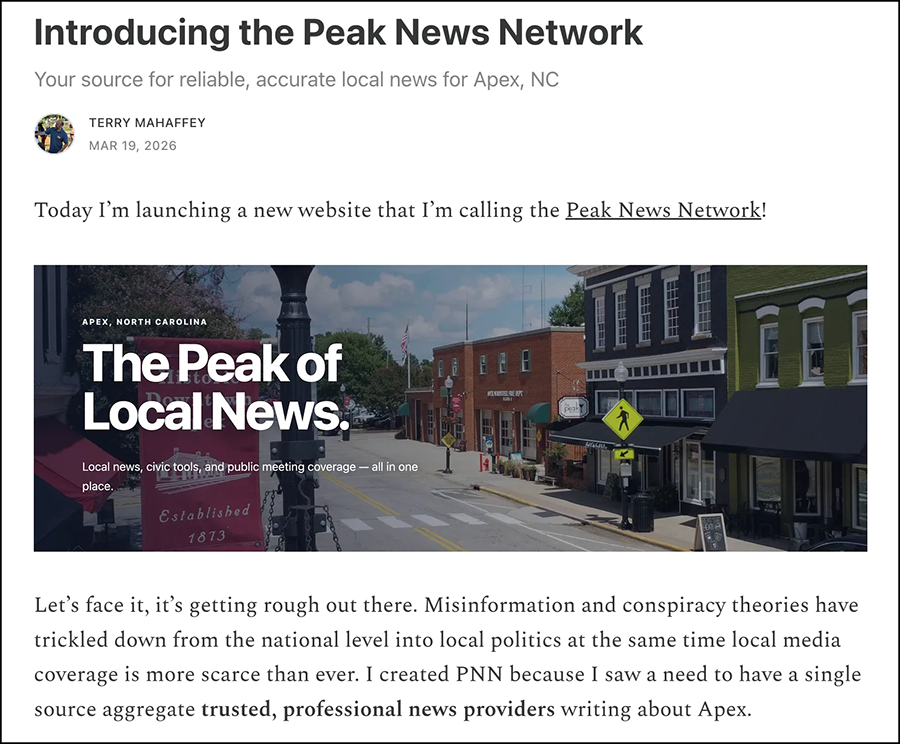
If we take Mahaffey at his word, the reason that this website was created is "to have a single source aggregate trusted, professional news providers writing about Apex."
Mahaffey elaborates on this and explains, "To be clear, the site is run and maintained by me but most of the content is not. It is an aggregation of several other news sources filtered on Apex."
And the Content Disclaimer on the website states, "I do not personally endorse, verify, or take responsibility for the content produced by the aggregated news sources. The articles, headlines, and summaries shown here are sourced directly from the publishers' feeds. The one exception is my own newsletter, which I author myself."
This Article Will Show You:
- Peak News Network does not appear to work the way Mahaffey describes it - the summaries are not "sourced directly from the publishers' feeds," and the system behind it, a password-protected platform called PeakIntelligence, includes tools for voter search and party registration tracking.
- PNN is one piece of a five-platform network that shares a single login and a single database, collecting your name, email, location, poll responses, project opinions, and home address - all tied to one profile controlled by one elected official.
- These tactics closely map to strategies developed and deployed by other political operatives - and I'll name them.
- What all of this means under North Carolina public records law - and why it can't work both ways.
How the Website Actually Works
The Substack article announcing this website describes it this way:

The key line here is, "an aggregation of several other news sources filtered on Apex".
Open your browser. Go to peaknewsnetwork.org. Right-click, view page source, click the Sources tab, then find the reference to app.js. Open it. You'll find a function called parseChangelog that loads every story from a file called PeakIntelligence_changelog.json - a name pointing to a separate processing system hosted at peakintelligence.org, another domain Mahaffey controls.
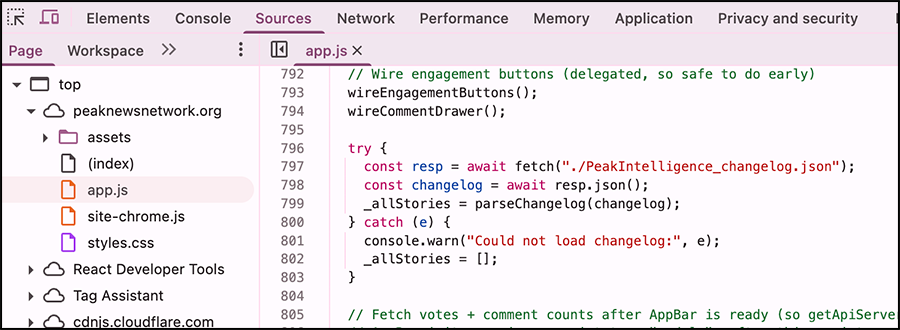
Now that we have that filename, you can open it directly at peaknewsnetwork.org/PeakIntelligence_changelog.json and you'll see the feed of news stories that have been collected from its sources.
The Content Filter
Every entry in that JSON file has a numerical score field. Each story is scored, based on whatever conditions Mahaffey has set up, so that any story scoring below 5 gets discarded. It never appears on the site. You never know it existed.
if (entry.score != null && entry.score < 5) continue;The website is indeed an aggregation of several other news sources filtered on Apex - however - a feed described as an automatic aggregation should not score and selectively suppress stories based on rules set by the operator.
That's not an automatic feed of news sites. It is an editorial system with Mahaffey as the gatekeeper.
The Summary Rewrites
Each story that appears on the Peak News Network includes a summary. And, according to Mahaffey, those "summaries shown here are sourced directly from the publishers' feeds."

That is misrepresenting what actually happens. The summaries are re-written; they are not sourced from the third party websites. In other words, he can completely reframe the narrative while misleading you to believe it's what the third party website said. That's what this "trusted" news source is actually doing.
A true news story aggregation service would pull stories from other third party websites and then display them on its own website. Which is how this website is described to function. But remember how it actually works - PeakIntelligence.org is actually receiving the feed. It then feeds the Peak News Network.
There is a 'middle-man' process scoring the articles - not to provide a feed of information, but to weed out content based on predetermined rules.
Here's an example:
Holly Springs Update has a Substack blog. This is their RSS feed: https://www.hollyspringsupdate.com/feed
One of the stories from that feed, to use as an example, is a story titled, "Apex (NC) Growth Is Booming. Town Leaders Are Now Asking: Is It Sustainable?"
And here is what that RSS feed provides for that story:
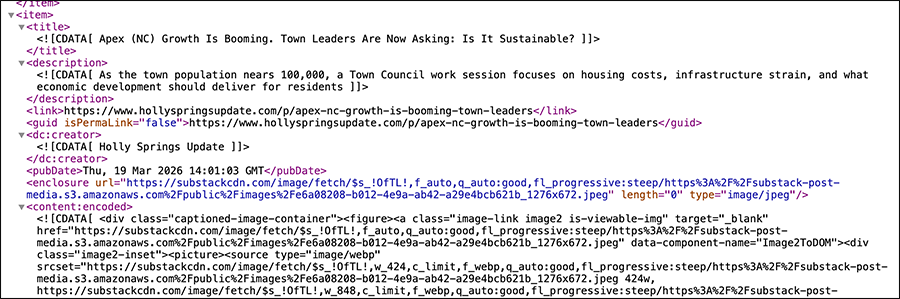
The relevant piece of this is the description, which is: "As the town population nears 100,000, a Town Council work session focuses on housing costs, infrastructure strain, and what economic development should deliver for residents".
Since Mahaffey tells us explicitly that the summaries are pulled directly from the 3rd party, this should be the same description shown on Peak News Network.
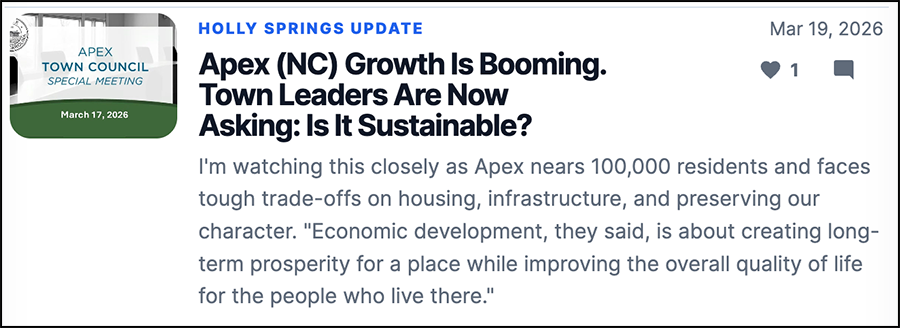
Interesting. A completely different summary using verbiage that appears nowhere in that article nor in its feed.
And no, that's not an anomaly. That's part of the PeakIntelligence.org manipulation of the feed that runs before it can be shown to you.
Read through them all and the pattern hits you immediately. Nearly every one is written in first person, as though Mahaffey is personally delivering the news to you:
- "Tonight I want to let you know..."
- "I'm encouraged that..."
- "I'm pleased to share…"
- "I'm watching this closely..."
- "I'm excited to invite you…"
The summaries are not coming directly from the third party. They appear to be auto-generated rewrites processed through Mahaffey’s PeakIntelligence system and written in a voice that reads like a personal message from a councilmember to a constituent.
Every story goes through the same system. Third-person journalism goes in. First-person messaging framed as if coming from an elected official comes out. And nowhere on the site is this transformation disclosed; the About page instead states the opposite.
There's A Name for This
In March 2024, NPR media correspondent David Folkenflik and Floodlight investigations director Miranda Green published an investigation into The Richmond Standard, a local news site in Richmond, California wholly owned by Chevron. The Richmond Standard carries genuinely useful community content - charity drives, street closings, youth soccer events. It is also operated by the city's dominant corporate interest, and stories unfavorable to that interest are omitted or softened.
Folkenflik and Green coined a term for what the Standard creates: not a news desert, but a news mirage - something that looks like local news but delivers a distorted reality shaped by the operator's agenda. As Folkenflik explained on NPR, a news mirage creates "a bit of a 'Truman Show' understanding of the community you're living in, where you are directed to things that are of value to the operator."
That is PNN. It provides real value - aggregated news, civic tools, a community calendar - and that value is what earns trust. But the person operating the site has political interests that shape what gets included, what gets excluded, and how everything is framed. The mechanism is just more sophisticated than Chevron's: instead of a PR firm selectively writing stories, Mahaffey built an automated pipeline that rewrites other people's journalism, scores every story through a system he controls, and filters the results before they reach the reader - all while telling visitors that content is 'sourced directly from the publishers' feeds.'
There is nothing wrong with a private citizen building a local news aggregator. Independent publishers do this every day. The critical distinction is that Mahaffey is not a private citizen in this context. He is an elected official running a platform including stories about the government on which he serves, while that government is the subject of active accountability reporting that involves him directly.
This Is Not a New Idea
The strategy of building controlled local news outlets that mimic independent journalism has a specific political history.
In fact, Mahaffey seemed to be well aware of this when we were chatting about newsletters a few months back:
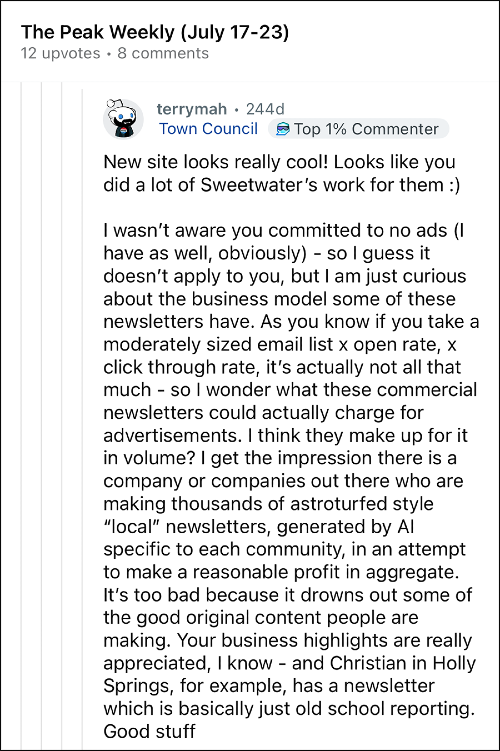
He criticized "astroturfed style 'local' newsletters, generated by AI..." and said, "it's too bad because it drowns out some of the good original content people are making."
Then... he went out and built one.
This is a tactic overwhelmingly pioneered, funded, and scaled by Republican political operatives.
Researchers have documented roughly 1,200 right-wing fake local news sites compared to fewer than 70 left-leaning ones. The largest network, Metric Media, was built by Brian Timpone who told the Washington Post, "I'm a biased guy. I'm a Republican" - in partnership with conservative talk show host Dan Proft.
Together they distributed algorithmically generated articles and pro-Republican content across all fifty states. The Columbia Journalism Review's Tow Center has spent years documenting how these sites bolster conservative talking points, serve as political platforms, and function as crisis management tools.
One media researcher at Northwestern University argued we should stop using euphemisms and just call these sites what they are: "Republican-backed local news sites that are strategic political communication."
Before the 2024 presidential election, Timpone's network distributed newspapers with "Catholic" in their titles across five battleground states - unaffiliated with the Catholic Church, with content designed to undermine Kamala Harris and boost Donald Trump.
That's the lineage. That's the playbook PNN descends from.
The Full Playbook
PNN didn't emerge in isolation. It's the latest addition to a pattern of behavior that maps, point by point, to strategies developed by known political operatives.
Here are six examples:
1. Flood the Zone
In 2018, Steve Bannon articulated his media strategy: "The Democrats don't matter. The real opposition is the media. And the way to deal with them is to flood the zone with shit."
Between his Substack newsletter, his Reddit activity, his Facebook presence, his Instagram, his TikTok, his YouTube, his BlueSky, his Threads, his Jira portal, the civic tools he constantly ships, and now PNN, Mahaffey produces a volume of content that makes it impossible for any single piece of accountability reporting to hold the public's attention.
As he explained on his social post in September, he uses SocialBu to crosspost, schedule posts, and run certain automations, including taking action on certain RSS feeds. SocialBu allows him to keep the firehouse running around the clock.
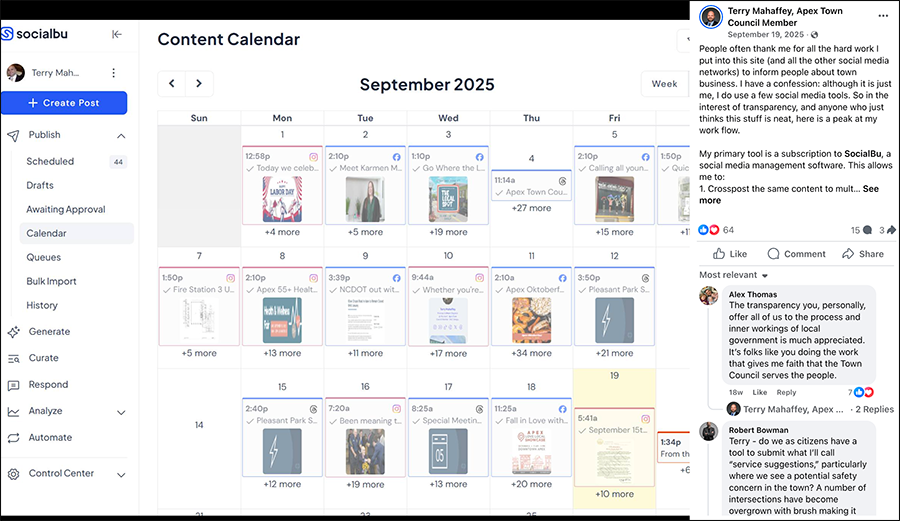
The zone doesn't need to be flooded with lies. It just needs to be flooded. When the volume of helpful content is high enough, critical comments and stories drown. His followers see a man who never stops building things for the community. What they don't see - because there's no room left on the screen - is the man those things are designed to distract from.
2. Discredit the Press
In 2016, Trump explained his attacks on journalists to CBS correspondent Lesley Stahl: "I do it to discredit you all and demean you all so when you write negative stories about me, no one will believe you."
Mahaffey's introduction of PNN - "Enough non-sense" - does this without naming anyone. His Substack announcement warns that "misinformation and conspiracy theories have trickled down from the national level into local politics."
The framing is clear: whatever else you've been reading is the problem. PNN is the solution. He doesn't have to attack critics by name. He just builds a world where they aren't included.
3. Accuse Your Opponent of Your Own Weakness
Karl Rove's signature move: accuse your opponents of doing the things you yourself are doing. If both sides are making the same accusation, most people pick the version they prefer and move on.
Mahaffey publicly labeled the journalist reporting on a data breach of his last little project a "Wake GOP political operative" - while deploying documented Republican media strategies himself. He cited a "$15,000 outside investigation" which he said cleared him.
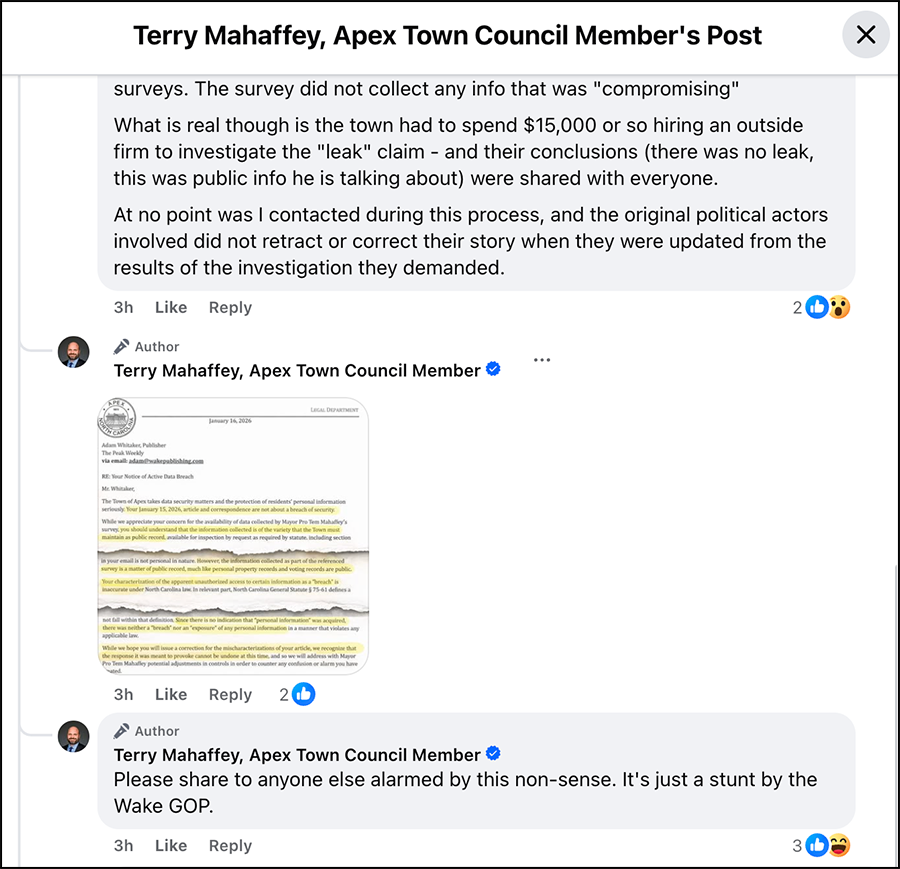
The Town themselves have contradicted Mahaffey’s claim that I am a Wake GOP political operative. The "15,000 investigation" appears to actually be a $3,378 payment to another law firm that they used to cite my data breach claims as false. The evidence of the data breach is still secured, it has been offered to the Town, but to date nobody has agreed to see it.
Rather than take accountability, Mahaffey instead attempts to discredit my reporting (which worked on a lot of people by the way) by painting me as a political operative.
Was his accusation a confession?
4. Attack the Strength
Rove also pioneered attacking an opponent's greatest strength rather than their weakness - the 'Swift Boat' strategy. The Peak Weekly's recent accountability reporting that has scrutinized Mahaffey is built on public records. The Town's own documents. Its own responses to records requests. Its own data. That sourcing makes the reporting nearly impossible to dispute on substance.
So Mahaffey doesn't dispute the substance. He attacks the credibility of the person who filed the requests.
5. Rebranding Public Resources as Personal Brand
Mahaffey turns official Town documents with the official Town seal and brands them with his logo.
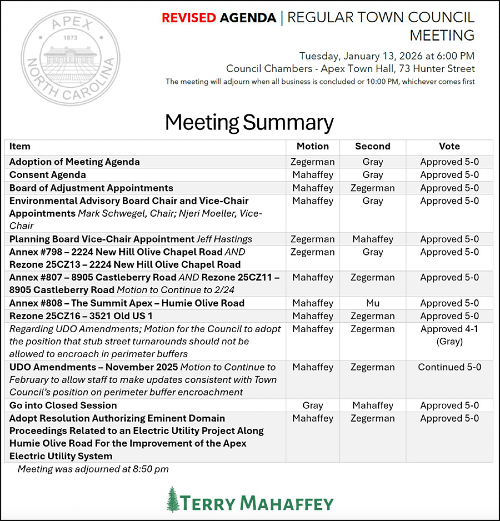
He takes video recorded by the Town, throws his logo on it, and then reshares. Here's this touching moment of Councilmember Mu being sworn in. Big moment for her. Big moment for Apex. But hey - don't forget about 🌲 Terry Mahaffey.

And I guess he wasn't a big fan of the Town's Capital Improvement Project Survey because of all the Town branding on it, so he made his own.
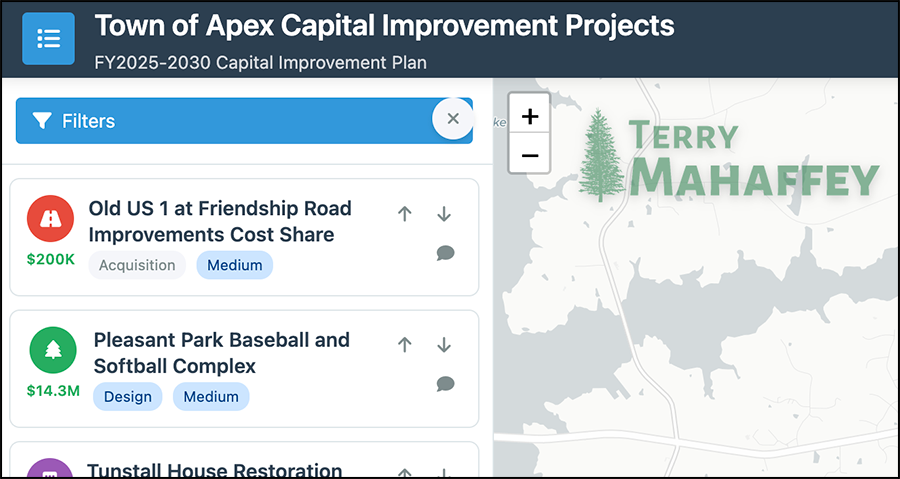
Over time, residents associate public information with Mahaffey's platform. WRAL's reporting becomes content "curated by Terry." Official Town Meeting Minutes become "Terry's Transparent Communication." This builds a constituency that feels personally grateful to Mahaffey.
When every piece of news arrives framed as a personal message — "I'm pleased to share…" "I'm concerned…" "I want you to know…" - it manufactures a parasocial relationship. Followers become resistant to negative information about the person who's been "looking out for them." This is how political loyalty is built at scale - not through policy, but through the feeling that someone is talking directly to you.
He recently boasted about having the largest Apex newsletter with close to 7,000 subscribers. Public servants don't need the biggest subscriber list. Candidates do.
6. Data Collection Through Civic-Appearing Tools
In 2013, a Cambridge University researcher developed an app called "This Is Your Digital Life" - a personality quiz that appeared harmless. In reality, it collected data from up to 87 million Facebook users, which was passed to Cambridge Analytica, a political consulting firm co-founded by Republican mega-donor Robert Mercer and advised by Steve Bannon.
The data was used to build psychological profiles of American voters and target them with tailored political messaging during the 2016 presidential campaigns of Ted Cruz and Donald Trump.
The Cambridge Analytica model established a principle: wrap data collection in something that appears to serve the user's interest.
The tools Mahaffey has built are genuinely useful. That is the point. The value proposition is what gets people to hand over the data. The question is what a sitting politician does with a database of residents organized by their home addresses, their geographic locations, their policy opinions, their infrastructure priorities, and their engagement patterns - especially heading into a future election cycle.
The fact that the Town of Apex already provides its own survey tools makes this question sharper. Why build parallel infrastructure unless you want the data on your own servers, outside of official channels and outside of public records requests?
Now Let's Talk About What He Knows About You
Everything above is happening on PNN. But PNN is not a standalone website. It is the newest node in a network of platforms that share one login, one database, and one purpose.
Five Platforms, One Database
Mahaffey operates at least five web platforms:
- Peak News Network (peaknewsnetwork.org)
- Wake Results (wakeresults.org)
- Wake Votes (wakevotes.org)
- Capital Improvement Projects (projects.peaknewsnetwork.org)
- Historical Tax Information (taxinfo.peaknewsnetwork.org)
If you want to participate in any of these (comment, vote, heart/like, rank a CIP project, etc - you have to register. Take a look at each of their registration forms (excluding wakevotes.org for a moment, but we'll come back to that one):
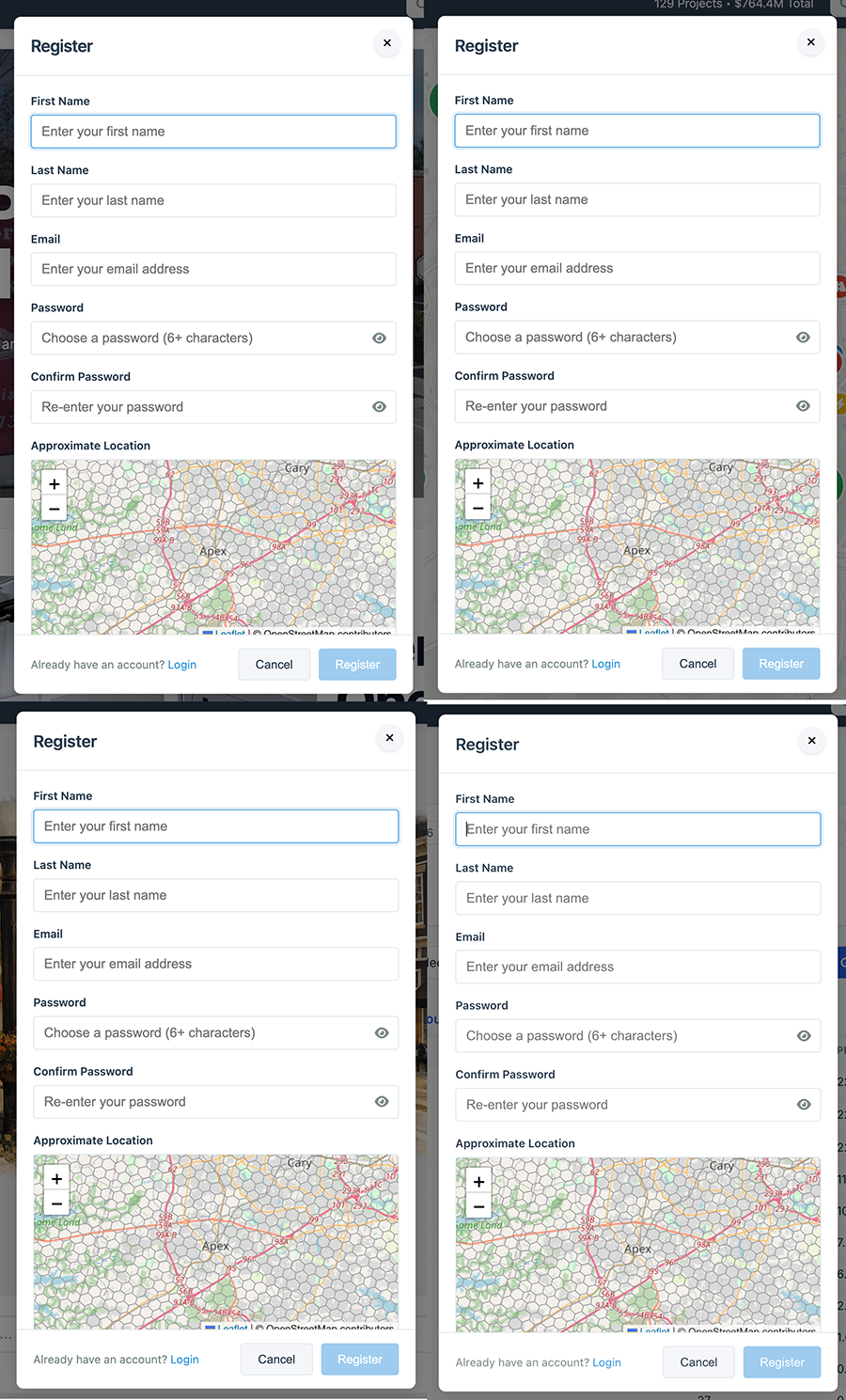
The fact that they all look the same isn't the issue. It's moreso the fact that they are the same.
If you register on one of them - you are registered on ALL of them.
Each of these websites run the same shared JavaScript module - appbar.js - that handles registration, login, and session management. A cross-domain cookie system allows a single account to persist across all four sites. The cookies last 365 days. Register once on any platform, and your identity follows you across the entire ecosystem for a year.
That means if you registered on the Capital Improvement survey website months ago, the moment you visit the new PNN website, the system already knows who you are - your name, your email, and your approximate location. And every heart, comment, and poll vote you make on PNN is tied to that same account.
It may feel like multiple websites or multiple accounts - but you are one file on Mahaffey's hard drive. There's a tool to share what you think about certain projects, a tool to interact with stories that resonate with you, and a tool to practice who you are voting for... and every single piece of information you input is tied back to a single file about you on Mahaffey's hard drive.
The Property Tax Lookup Tool
The 5th tool is the most recently added one, and it allows you to look up historical property tax information on your home.
"I’ve recently added a new tool to look up (and chart) property tax history in Apex, and I have plans for several more."
This one doesn't have the same login as the others. All it asks for is your address to look up the data. Pretty useful tool, right?
Indeed it is. And, again... that's the point.
For the other tools, asking for your home address would be too aggressive. So instead, he just asks for your general location.
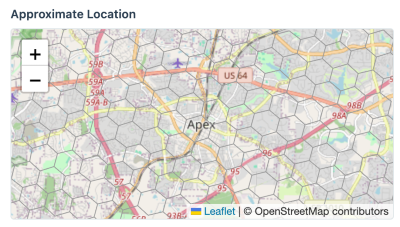
The system uses Uber's H3 geospatial indexing library at resolution 8 - each cell covers approximately 0.74 square kilometers, roughly the size of a few neighborhood blocks.
Well...if you really wanted to tie an address to the individual but thought it would be too aggressive to ask that for a simple news aggregator or project survey, then isn't a tool that requires your address to provide the data a perfect way to fill in the gap?
And remember - even though it doesn't ask you for your name or email... it already knows who you are.
The sample ballot tool at wakevotes.org does this too. The code sends your address and interactions as event data to his tracking setup, allowing them to be associated with other information collected about you.
More About WakeVotes.org
This tool is interesting. It might be the only thing owned by Mahaffey that doesn't have his logo on it.

It's just a simple splash screen inviting you to input your home address to see a sample ballot. There is no indication of who owns this website, but the color scheme is similar to Wake County's and the choice of website URL being wakevotes.org - and it’s easy to see how some users could assume it was a government‑run site.
Once you enter your home address, you then see a welcome popup. Still no mention of who this website even belongs to.

That pop-up encourages you to click the bubble on your choice of political candidate before then allowing you to see the sample ballot:

Now, unbeknownst to you, this javascript code has fired and logged your home address to Terry's database:
function navigateToBallot(filter, ballot) {
gtag('event', 'navigate_to_ballot', {
'event_category': 'ballot_navigation',
'event_label': ballot,
'filtered_result': filter, // THIS IS THE ADDRESS
'value': 1
});
Then, if you toggle a selection, click on a candidates name, generate a share link, or print the ballot, this part of the code then adds that data to his file on you:
// When someone toggles a candidate selection:
gtag('event', 'toggle_visibility', {
'event_category': 'button',
'event_label': point.name, // The candidate name!
'value': dataItem.visible ? 1 : -1 // Selected or deselected
});
// When someone clicks on a candidate's name
boxDiv.onclick = () => {
gtag('event', 'info', {
'event_category': 'button',
'event_label': dataItem.name,
'value': 1
});
window.location.href = url;
};
// When someone generates a link to share their choices:
gtag('event', 'link', {
'event_category': 'button',
'ballot': ballotName, // Which ballot style (geographic area)
'event_label': queryString, // THE ENTIRE SET OF CHOICES
'value': 1
});
// When someone prints their ballot:
gtag('event', 'print', {
'event_category': 'button',
'ballot': ballotName,
'event_label': queryString, // Again, all their choices
'value': 1
});
The Senior Software Developer / Politician
A councilmember who wants to help residents stay informed makes a Facebook page... Maybe a simple WordPress site.
He doesn't build a system that uses Uber's H3 hexagonal geospatial indexing library - the same technology ride-share companies use to map demand patterns and optimize driver placement. He doesn't deploy cross-domain authentication cookies with 1 year persistence across five websites (and more to come as he claims). He doesn't build an automation content pipeline hosted on its own separate domain that scores, filters, and rewrites third-party journalism. He doesn't integrate Leaflet mapping libraries with H3 resolution-8 hex cells to capture user locations at neighborhood-block precision. He doesn't recreate existing tools that capture your interactions and log them. He doesn't manage a multi-platform, multi-source data aggregate and social posting tool with his own personal logo added to official Town records.
Mahaffey is a senior software developer at Microsoft. He knows exactly what these tools are. He knows what H3 is designed for. He knows what cross-domain cookies do. He knows the difference between displaying an RSS feed and building a scoring pipeline that filters content through an AI before anyone sees it. None of this is accidental. None of this is a hobby project that got out of hand. None of this is about pulling news sources together. None of this is focused on serving you.
Think about the simple fact alone that he owns a domain called PeakIntelligence.org that runs a lot of this behind the scenes. That website is password protected, but if you look at the source code of the page, you can see what the navigation looks like when he's logged in:
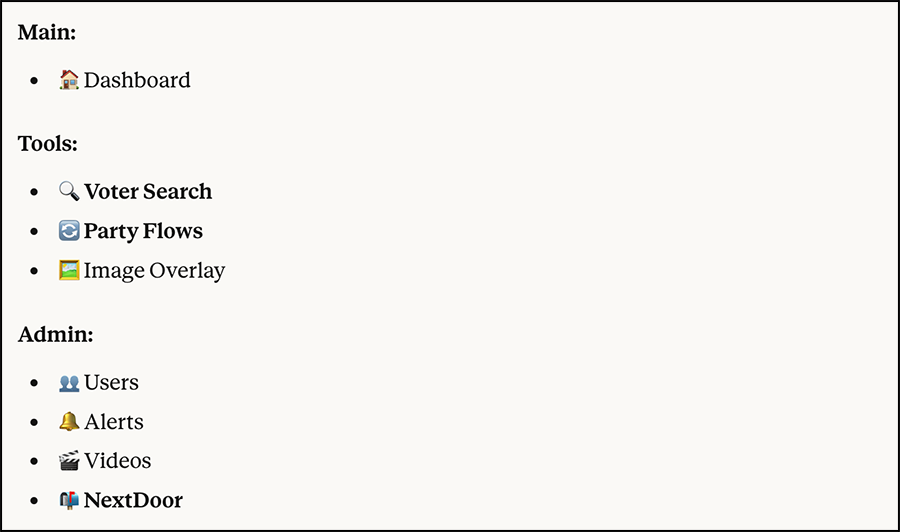
‘Voter Search’ suggests a tool for querying the database of people in the system. ‘Party Flows’ suggests tracking how voters may be switching parties. Without access, the precise functions are unknown, but the labels align with voter‑profiling concepts.
This is a system architected by a professional software engineer, using enterprise-grade tools designed for geospatial analysis, behavioral tracking, political interest tracking, and content personalization at scale.
What the Combined Database Can Contain
For a resident who has engaged across these platforms, the combined record potentially includes:
- Full name and email address
- Geographic hex cell at neighborhood-level precision and/or home address
- Which news stories they engaged with
- Their poll responses on policy questions
- Which infrastructure projects they support or oppose, and their written explanations
- Their property tax lookup history
- Their interest in election information, results, and their sample ballot selections
That's not a civic tool portfolio. Functionally, this resembles a voter file, and in some ways is richer than what many political campaigns pay consultants to build. And he built it and paid for it with campaign donation dollars and by offering people useful things and asking them to click on a map.
Cambridge Analytica used a personality quiz… Mahaffey’s model is structurally similar: useful tools that also function as data collection mechanisms, but in a hyper‑local context and without clear disclosure.
Public Records & Funding
These platforms create a lot of confusion around public records.
Mahaffey categorizes PNN as a personal project.
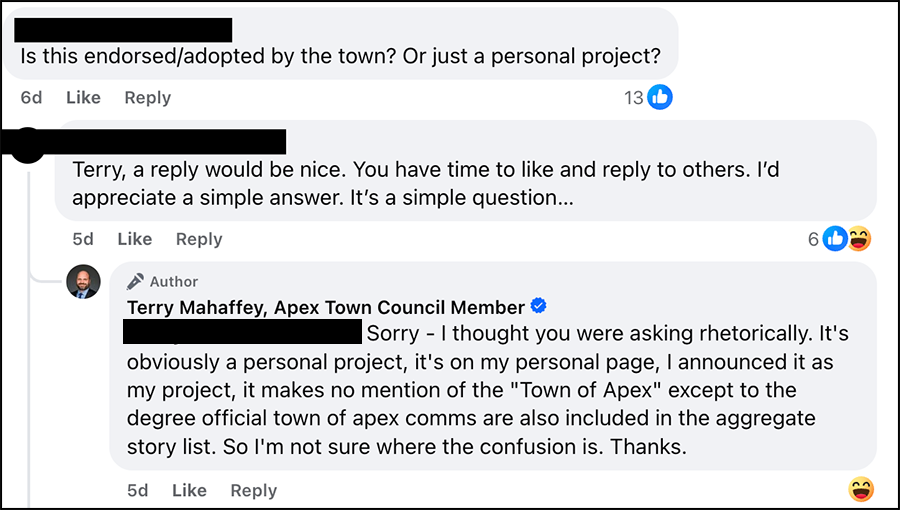
There are a few problems with that, though:
- North Carolina Law (Chapter 132-1) defines public records as, "...in connection with the transaction of public business by any agency of North Carolina government or its subdivisions." The platform is irrelevant. Your own definition is irrelevant. What matters is whether you are conducting official business or not.
- Both Mahaffey and the Town of Apex Attorney both stated on record that the information collected in Mahaffey's Capital Improvement Projects website is in fact public record. If that personal project is treated as public record, it raises serious questions about how this new platform should be classified under the same law.
- If the website is a personal project, along with the tools used and social media profiles used to promote it, why are the tools being paid for with campaign donations?
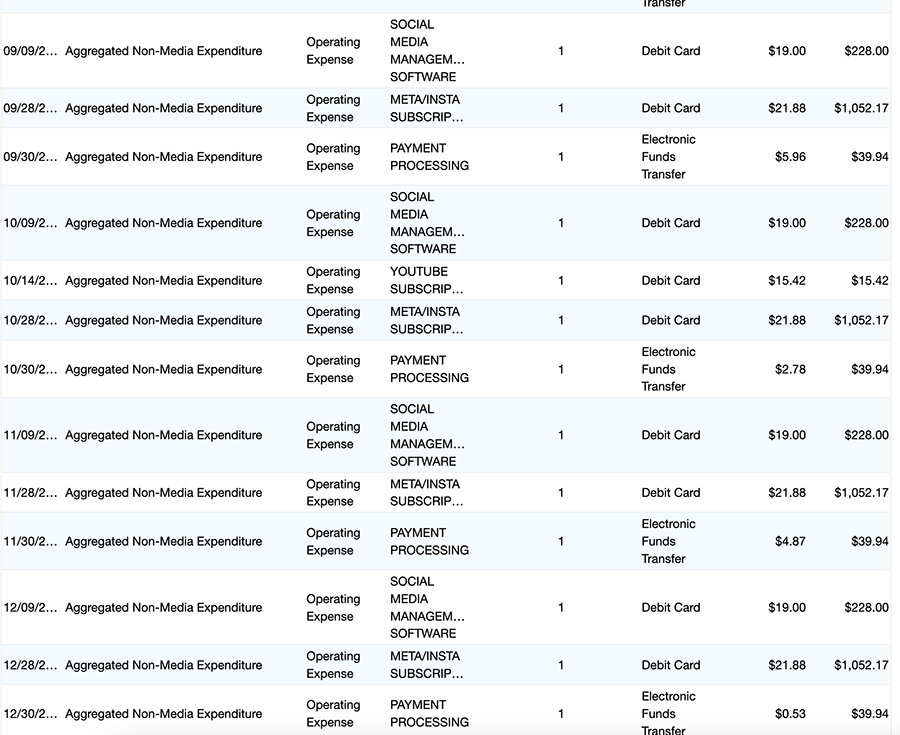
They cannot be both a public service and a private project whenever each characterization is more convenient.
The Pattern
One tactic might be a coincidence. Two might be a bad habit.
But an automation-powered editorial pipeline that rewrites other people's journalism in a politician's voice without disclosure. A scoring system that silently filters what residents see. A geospatial registration system that maps users to neighborhood-level hex cells using Uber's H3 library. A cross-platform authentication system that ties engagement data to identified, located users across five websites with year-long cookies. Automated social media flooding paid for with campaign donations. Active suppression of independent journalism on a community subreddit. A "Pro Tip" coaching residents to narrow their public records requests. And a stated mission to combat "non-sense" that conveniently frames all critical coverage as illegitimate.
Taken together, this looks less like a civic project and more like a political playbook.
And every piece of it runs on data that you volunteered because the tools were helpful, the registration seemed harmless, and nobody told you it was all connected.
Now you know.
Technical evidence referenced in this article — including PeakIntelligence_changelog.json, app.js, appbar.js, and auth.js — is publicly accessible in the source code and data files served by peaknewsnetwork.org and associated Mahaffey-operated domains. Readers are encouraged to verify any claim independently using their browser's developer tools.
Sources:
- NPR / Floodlight: "Chevron owns this city's news site. Many stories aren't told." David Folkenflik and Miranda Green, March 2024.
- NPR Consider This: "What Happens When A Powerful Corporation Owns The Local News?" April 2024.
- Nieman Journalism Lab / Harvard: "How NPR and Floodlight teamed up to uncover fossil fuel 'news mirages' across the country." May 2024.
- Columbia Journalism Review / Tow Center for Digital Journalism: "'Pink Slime': Partisan journalism and the future of local news." 2024.
- Columbia Journalism Review / Tow Center: "The rise and rise of partisan local newsrooms." 2024.
- Columbia Journalism Review / Tow Center: "Hundreds of 'pink slime' local news outlets are distributing algorithmic stories and conservative talking points." December 2019.
- Poynter Institute: "An illustrated guide to 'pink slime' journalism." October 2023.
- Freedom Forum: "Pink Slime Journalism: Separating Ethical News From Propaganda." November 2024.
- University of Cincinnati: "UC journalism professor explains 'pink-slime' journalism." August 2023.
- Northwestern University Local News Initiative: "As 'pink slime' aims to fill local news vacuum, is anyone reading?" March 2023.
- Newsweek: "Steve Bannon's 'flood the zone' strategy explained amid Trump policy blitz." February 2025.
- CNN: "This infamous Steve Bannon quote is key to understanding America's crazy politics." November 2021.
- CBS News: "Lesley Stahl says Donald Trump admitted attacking press to 'discredit' media coverage." May 2018.
- Committee to Protect Journalists: "The Trump Administration and the Media." April 2020.
- CNN: "Both sides using Rove's campaign strategy this year." August 2012.
- Wikipedia: "Facebook-Cambridge Analytica data scandal."
- Brookings Institution: "Data misuse and disinformation: Technology and the 2022 elections." June 2022.