The Deal Made Without You (NC Children's Hospital Part II)
Have you read Part 1? If not, I suggest reading that first.
This piece is based on public records, signed correspondence I have obtained, recorded statements made at the April 28, 2026 Apex Town Council meeting, and analysis of publicly available budget and capital improvement documents. Where I have drawn conclusions, I have tried to clearly distinguish between documented facts and my own interpretation. Where I have quoted Town officials, I have done my best to capture their statements accurately, but readers should consult the meeting recording for full context. If anything in this article is factually inaccurate, I want to know. Please contact me at adam@thepeakweekly.com and I will issue corrections promptly.
In part 1 of this story, published last Thursday, I explained how the Town of Apex committed approximately $61M to the Children's Hospital (referred to in Town correspondence as 'Project Law'), without any public vote or discussion, and detailed how that is directly affecting your bills.
It's not a political story. It's not even a hospital story.
It's a story about how the deal happened.
But it's not my story.
It's really the Town Council's story and the Town Manager's story as most of it is told in their own words, their own actions, and the laws that direct those actions.
In fact, my reporting on all of the documented and verifiable facts was so spot on, I actually predicted the future.
Towards the end of the article, I said this:
I said that the MOU that was approved last week was theater. I wrote that the Town had committed to the children's hospital deal in 2025, in private, in venues that produced no public record, an apparent violation of open meetings law.
And that the MOU existed primarily so the Town could point to it rather than to the actual relevant documents.
And that's exactly what happened:
"I want to be clear about the children’s hospital: the MOU Council approved on April 28 is non‑binding and does not obligate the town to spend money today." - Terry Mahaffey, via Substack
That's the Town's rebuttal, at least as told by Mahaffey.
And it's a great rebuttal because the statement is 100% true.
But it's also 100% irrelevant. A designed distraction.
Because the commitment of your taxpayer money was made a year ago, behind closed doors without any public discussion or vote, it doesn't need to be made again in some ceremonial MOU presentation.
Let's talk about commitments
North Carolina Law is very specific about what government staff and officials can do behind closed doors, and what must be done in front of the public.
To better illustrate what this all means, focus on the word "commitment".
Here is what North Carolina General Statute 160A-75(c) says:
Translation: Council is required, by law, to vote before committing the expenditure of public funds.
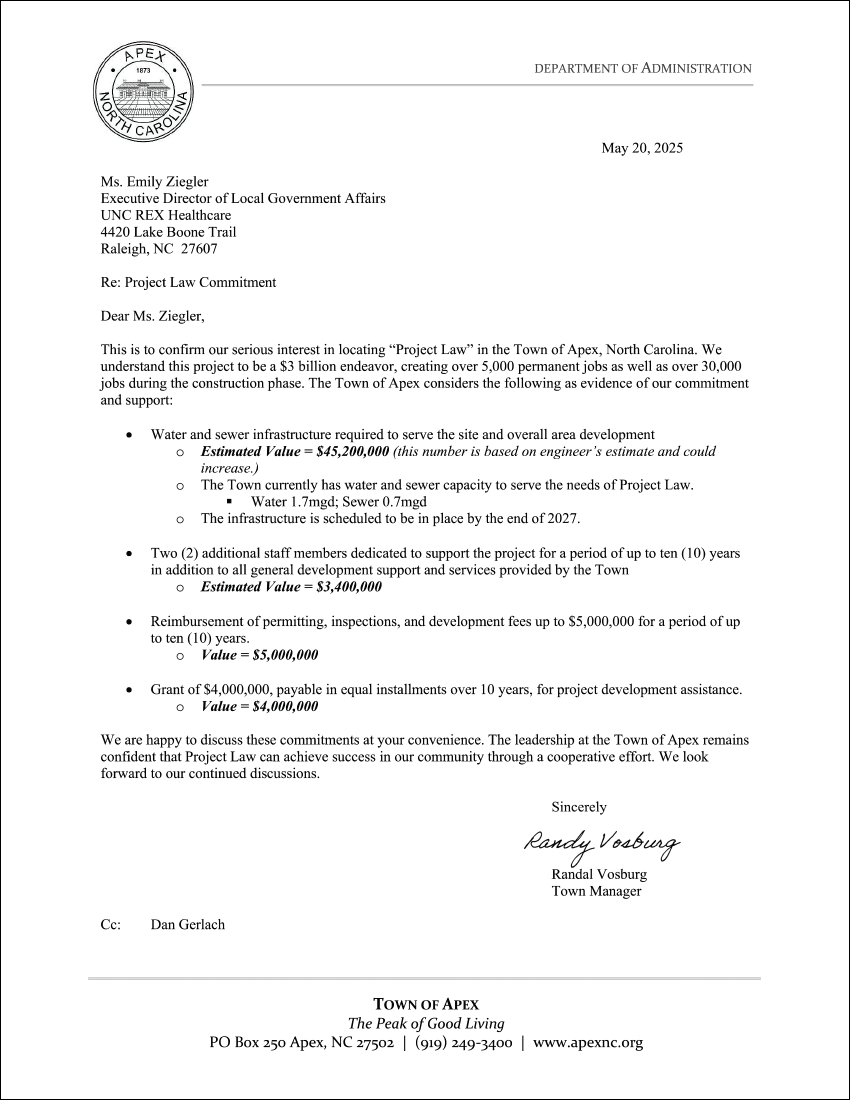
Scroll back up and look at Vosburg's letter. The "Project Law Commitment" letter. Look at all of those specific funds that have been committed. Did that happen before or after a public vote?
Here's what North Carolina General Statute 143-318.11(a)(4) says:
Translation: Before signing any commitment related to economic development, it must be approved in open session.
More Evidence of Commitment
Let's revisit that quote from above again:
"I want to be clear about the children’s hospital: the MOU Council approved on April 28 is non‑binding and does not obligate the town to spend money today." - Mahaffey, via Substack
That's a solid argument. The MOU signed April 28, 2026 did not make any commitments.
I agree.
The MOU made zero commitments. Because the commitments were made last year when the Town Manager delivered a signed letter stating:
"The Town of Apex considers the following as evidence of our commitment..."
In addition to that, more from Apex Town Manager, Randy Vosburg:
"Originally, we committed to or spoke about $8 million over 20 years."
"As part of our discussions with NC Children's, we put that forward as a commitment for us towards this project."
"You look at what we're putting out on an annual commitment."
Apex Town Council Member, Terry Mahaffey:
"This MOU reflects our commitment."
"I hope that the hospital and others watching take away just the commitment that the town of Apex has."
They used the word because it was the word
"They were speaking about the project, maybe they just used the wrong word..."
Well, then let's go to the letter addressed to the Executive Director of Local Government Affairs, UNC REX Healthcare
"We are happy to discuss these commitments at your convenience."
Signed by Randy Vosburg on Official Town Seal Letterhead
And the subject line of that letter?
"Project Law Commitment"
One more thing about the MOU itself. Across the documentary record of this deal, the word "commitment" appears 15 times. Four times in Vosburg's letters. Ten times in the April 28 meeting. The MOU - the only document the Town seems willing to discuss - uses the word zero times. The same Town Manager who titled his first letter "Project Law Commitment" signed an MOU eleven months later that doesn't use the word once. That's the strategy.
The contracts already exist
When Vosburg presented the MOU to Council on Tuesday, he opened with this:
"You've been teased on a couple of agendas in the past, but that was because we were still working through some of the additional details. All the attorneys got together."
After the vote, he closed with this:
"I wanted to pass kudos to Legal. Lori and Brian - extensive work on this agreement."
In other words, the Town of Apex's and NC Children's counsel performed extensive joint drafting work prior to Tuesday's meeting. Lawyers do not perform extensive joint drafting on documents that don't matter. They do that work on binding instruments - the kind that contain dollar figures, performance terms, and dispute resolution provisions.
By Vosburg's own words, that work was finished before Tuesday. The public never saw it.
Council Member Ed Gray, defending the MOU as transparent, said this twice during the meeting:
"We're essentially telling Randy, go sign the document that we told you to go and sign."
Wait. This is the first time a major economic development investment is being discussed in open session and there are already contracts that council has already directed the Town Manager to sign?!
Thank you to Shane Reese for confirming:
"We're telling Randy to sign the paperwork and do what we already told him to do."
Council had already directed the Town Manager - before Tuesday's vote - to take specific actions on this deal. That direction does not appear in any open-session vote in the public record.
Remember Sue Mu's comment?
"You have to do this, we have to do this, we all agree with this."
Council Member Mu took office in December 2025 - after the commitment letters had been signed. By Tuesday, the deal had been in motion for a year. Her description - 'you have to do this' - accurately reflects the position the Council was in. The substantive decision had been made. The vote was a formality.
Tuesday's MOU vote, by the Town's own description, was not the moment Council decided. It was the moment Council told the public about decisions that had already been made and contracts that had already been written.
The MOU was theater. It did nothing. Because it didn't need to do anything.
The budget already aligns to it
The Town hasn't just discussed commitments. The Town has already structured its budget around them.
The proposed FY26-27 budget - presented by the same Town Manager who signed the 2025 commitment letters - contains the rate and tax increases necessary to fund the deal. Residential water rates up 4%. Sewer up 4%. Wholesale water up 12.5%. Property tax up $0.0354 per $100 of value. Operating fund transfer to water and sewer capital projects up 143%. Capital Reimbursement Fee transfer up 193%. General Fund Debt Service "Reserved for Future Expenditures" up 60% — meaning the Town is building debt service capacity for bonds that haven't been issued yet.
The Capital Improvements Plan was revised between July 2025 and the proposed FY26-27 budget. In nine months, the total water and sewer capital plan grew from $115 million to $147 million. That's $32 million in new projects added to the plan in less than a year. The largest single jump - the Cary Subtotal for Western Wake regional treatment expansion - went from $36.1 million to $74.7 million. A $38.6 million increase, in nine months, for the regional treatment facility that will serve the new hospital.
UNC Health has purchased the $90 million land. Two Town staff have already been allocated to the project. The capital plan has been revised to deliver the infrastructure. The rate structure has been built to fund it.
A non-binding cooperation framework does not move budgets, restructure rates, or trigger $32 million in capital plan additions. Commitments do.
Why this matters
NC General Statute 160A-75 requires a Council vote to commit public funds or bind the city to a contract. The public record contains no Council vote authorizing the May 20 or June 25, 2025 letters before they were signed.
NC General Statute 158-7.1 requires public notice and a Council hearing before an economic development appropriation is made. The statute attaches these requirements to the commitment, not to the funding. This distinction is structural and intentional. If the requirements only attached to funding, a town could privately commit to a private company, allow that company to spend tens of millions in reliance, build infrastructure around the deal, and then "comply" with the statute by holding a public hearing right before writing the check. The hearing would be empty. Every substantive decision would already be made.
"Any actual funding would require a separate, publicly noticed agreement and a Council vote." - Mahaffey, via Facebook
That's what council member, Terry Mahaffey, said.
But that is not what GS 158-7.1 says.
The statute attaches procedural requirements to commitment, not funding.
The commitments were made in 2025. The public notice and Council vote were not.
NC General Statute 143-318.11(a)(4) prohibits closed sessions from approving economic development commitments.
By Mahaffey's own words on Tuesday - "this is not the first time we've seen this agreement... we've been involved every step of the way" - Council was substantively involved in this deal across multiple closed sessions over the course of more than a year. To be clear, "being involved" in economic development isn't problematic in itself. The problem is when the commitment of the taxpayer money has already been made - almost a year before the first ever open session comments.
And by Gray's own words on Tuesday - "We're telling Randy to sign the paperwork and do what we already told him to do" - that involvement included Council instructing the Town Manager to take specific actions before Tuesday's public vote. That conduct is what the statute prohibits.
The questions
Ask yourself these questions. If there is no financial commitment to the hospital,
then...
- Why did the Town Manager sign letters of commitment?
- Why did Council and the Town Manager consistently refer to those conversations as commitments?
- Why are specific dollar amounts listed and already worked into the budget and CIP that they are passing now?
- Why did the lawyers all get together and already draft contracts?
- Why did council already tell Randy to go sign the contracts?
If you haven't done it already, click here to see the letters
And click here to hear all of this I've shared with you directly from the source.